
STREAMLINED HEALTHCARE OPERATIONS THROUGH SOA AND BPM FRAMEWORKS
ORGANIZATION
The client is a leading provider of healthcare and social services, operating through an extensive network of facilities and service organizations. Established in 1986, the organization manages:
- 18 acute care hospitals
- 1 dedicated heart hospital
- Outpatient care facilities
- Physician practices
- Skilled nursing and long-term residential care facilities
- Clinics
- A managed care organization
Additionally, the organization operates through regional Strategic Service Units (SSUs) and employs over 28,000 staff, including 1,045 integrated physicians and 4,450 medical staff members. By FY2007, it had become a prominent entity in healthcare, aiming to modernize and streamline its operations.
The client’s strategic goals included:
- System Integration: Unifying clinical and revenue systems to optimize workflows and improve efficiency.
- Enhanced Record Management: Providing comprehensive and accurate electronic patient records to improve patient services.
- Interoperability: Establishing a single electronic patient record system across all facilities for seamless care delivery.
CHALLENGE
The client faced significant technical and operational challenges, including:
- Fragmented Interfaces:
- Numerous point-to-point interfaces between disparate systems at various organizational levels (region, SSU, facility, and clinic).
- Inconsistent business logic across these interfaces.
- HL7 Message Transmission:
- Complex requirements to transmit HL7 messages between heterogeneous health information systems (HIS).
- Variability in HL7 message guidelines (VMDs) based on event types.
- Inconsistent Data Handling:
- Disparities in electronic patient records across systems.
- Irregularities in exception handling, auditing, reporting, and centralized message logging.
- Scalability Concerns:
- Disparate message volumes and evolving business requirements.
- Inability to efficiently onboard new systems and interfaces.
TECHNICAL SOLUTION
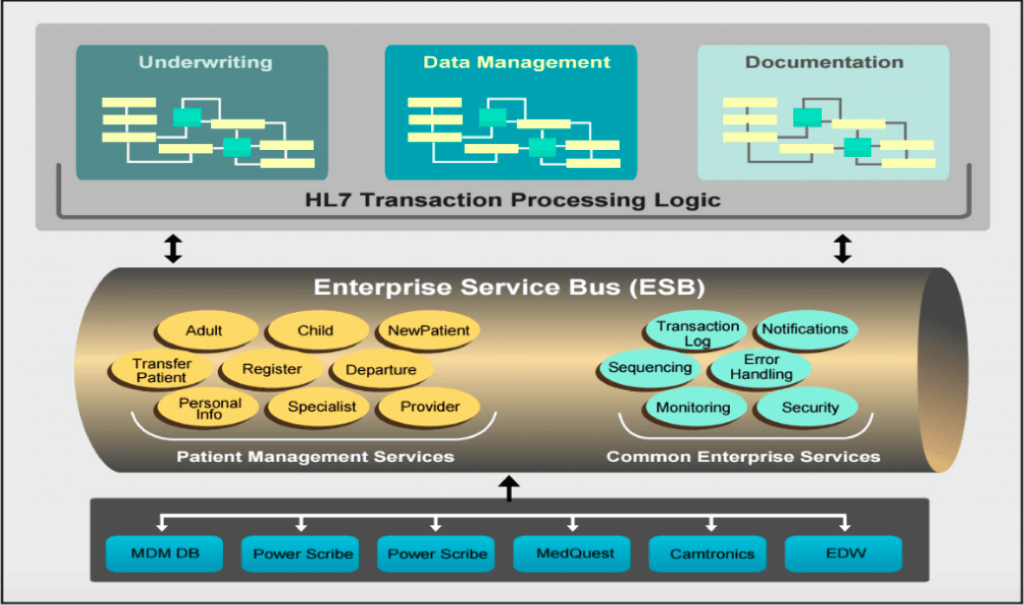
XTIVIA implemented an innovative integration solution, leveraging Event-Driven Architecture (EDA) and Service-Oriented Architecture (SOA) combined with a Common Information Model (CIM) approach. This robust, scalable, and adaptable architecture delivered:
- Integration and Decoupling:
- Real-time, one-to-many information exchange across internal systems.
- Decoupled message flow from translation and transformation logic, fostering scalability and flexibility.
- Reusable Components:
- Abstracted, reusable components for common business processes.
- Adaptability to meet dynamic business requirements.
- Exception Handling and Auditing:
- Centralized exception handling, auditing, and reporting capabilities.
- Streamlined transaction processing with consistent error management.
- Future-Ready Framework:
- Designed to accommodate the seamless addition of new systems or interfaces.
- Standardized information mapping using a Common Information Model (CIM).
BUSINESS RESULTS
The implemented solution significantly enhanced operational efficiency, data integrity, and patient care quality. The key benefits included:
- Enhanced Patient Records:
- A unified and consistent view of patient data across all business units.
- Real-time updates to electronic patient records.
- Optimized Processes:
- Billing processes synchronized with patient services for improved accuracy.
- Streamlined workflows with reduced redundancies.
- Scalability and Extensibility:
- A reusable and scalable architecture capable of supporting future integrations.
- Simplified onboarding of new systems and interfaces.
- Integrated Systems:
- Comprehensive integration of disparate healthcare systems, ensuring interoperability and process consistency
KEYWORDS
Event-Driven Architecture (EDA), Service-Oriented Architecture (SOA), HL7 Integration, Common Information Model (CIM), Business Process Management (BPM), Healthcare IT Interoperability, Real-Time Data Exchange, Integration Frameworks, Transaction Auditing, Exception Handling Mechanisms, Unified Patient Records, Seamless Systems Integration, Scalable IT Solutions, Transforming Healthcare Delivery, Optimized Billing and Revenue Processes, Future-Ready Healthcare Systems, Operational Efficiency in Healthcare, Advanced Data Management Solutions, Patient-Centric IT Frameworks, Healthcare Digital Transformation
SOFTWARE
Event-Driven Architecture (EDA), Service-Oriented Architecture (SOA), Common Information Model (CIM), HL7 Protocol, Business Process Management (BPM), Real-Time Data Exchange, Healthcare Integration, Unified Patient Records, Scalable Architecture, Operational Efficiency
Let's Talk Today!
No obligation, no pressure. We're easy to talk with and you might be surprised at how much you can learn about your project by speaking with our experts.
XTIVIA CORPORATE OFFICE
304 South 8th Street, Suite 201
Colorado Springs, CO 80905 USA
Additional offices in New York, New Jersey, Texas, Virginia, and Hyderabad, India.
USA toll-free: 888-685-3101, ext. 2
International: +1 719-685-3100, ext. 2
Fax: +1 719-685-3400
XTIVIA needs the contact information you provide to us to contact you about our products and services. You may unsubscribe from these communications at anytime, read our Privacy Policy here.