

SUMMARY:
Forward-looking organizations must measure the true economic value of IT talent by prioritizing total impact and outcomes delivered per unit cost, rather than relying on misleading surface-level hourly rates, to secure a competitive advantage.
- Focusing only on direct costs ignores critical variables that define actual value, such as throughput, quality, decision velocity, and long-term knowledge stability.
- Leaders can assess talent across six key dimensions, including Productivity Yield, Durability of Deliverables, and Knowledge Capital, to move beyond simple cost analysis.
- A resource with a higher hourly rate may ultimately result in a lower effective total cost for a project due to less rework, higher accuracy, and faster time-to-value.
- Organizations that treat resources as mere commodities risk undermining crucial dimensions like speed, quality, and stakeholder trust, leading to false economies and greater hidden costs.
The strategic choice when selecting IT talent is not “Who costs less?” but rather “Who moves the organization forward more effectively and with fewer downstream risks?”.
Table of contents
Organizations often default to comparing resources based on cost. On paper, the calculation seems simple: Resource A charges $100/hour, Resource B charges $150/hour; therefore, Resource A must be the more economical choice.
But in practice, this arithmetic rarely reflects reality. Hourly rates do not capture the actual cost of talent, but rather the value delivered to the business.
Why Hourly Rate ≠ Real Value
Focusing only on direct costs ignores critical variables:
- Throughput: How quickly can the resource produce outcomes of acceptable quality?
- Quality: How much rework, oversight, or additional QA effort is required?
- Decision Velocity: Does the resource enable or slow down business decision-making?
- Stability: Is knowledge retained, or will turnover create repeated onboarding costs?
These factors often outweigh the initial rate difference. A cheaper resource who introduces delays, defects, or coordination overhead can end up costing significantly more in total.
A Practical Framework for Assessing Value
To move beyond surface-level cost analysis, leaders can assess talent across six dimensions:
- Productivity Yield
- Output per unit time is more important than the time billed.
- Example: A senior developer may cost 40% more but complete tasks in half the time with fewer defects.
- Durability of Deliverables
- Well-structured code, reliable analysis, or robust designs minimize long-term maintenance.
- Short-term savings vanish quickly if quality debt accumulates.
- Initiative & Ownership
- Independent problem-solvers reduce escalation overhead.
- Proactive resources anticipate risks rather than react to them.
- Collaboration Efficiency
- Strong communicators accelerate alignment across teams.
- Poor communication amplifies confusion and delays.
- Client & Stakeholder Confidence
- Trusted individuals require less justification and review.
- Repeat requests for the same resource signal a clear value.
- Knowledge Capital
- Long-tenured resources build context that lowers ramp-up time for future work.
- High turnover or low knowledge transfer can lead to hidden costs.
Case Analysis: Cost vs. Value
- Resource A: $100/hour, requires frequent review, average quality, 20% rework rate.
- Resource B: $150/hour, works independently, delivers accurate outcomes, and has minimal rework.
For a 100-hour project:
- Resource A takes 120 hours due to errors and clarifications → $12,000 total.
- Resource B completes the work in 90 hours with minimal rework, resulting in a total cost of $13,500.
While Resource B appears costlier on the surface, the effective cost per unit of usable output is lower, with added benefits: higher quality, lower management overhead, and faster time-to-value.
Strategic Implication for Leaders
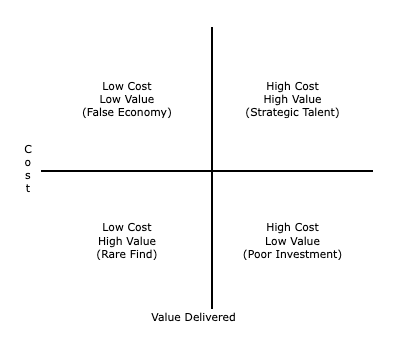
Organizations that treat resources as commodities risk false economies. Cost-driven selection often undermines speed, quality, and stakeholder trust—dimensions that are crucial to achieving a competitive advantage.
Forward-looking leaders adopt a value-based lens:
- They measure ROI in terms of outcomes delivered per unit cost, not raw hourly rates.
- They prioritize talent that accelerates business momentum, reduces risk, and strengthens institutional knowledge.
- They recognize that hidden costs—from delays to reputational risk—are often greater than direct costs.
Conclusion
The myth of “cheaper talent” persists because cost is easy to quantify, while value is harder to measure. However, the organizations that thrive are those that resist the illusion of savings and instead focus on total impact.
When choosing between resources, the better question is not “Who costs less?” but “Who moves us forward more effectively, with greater confidence and fewer downstream risks?”
That is where the fundamental economics of talent reside—well beyond the price tag.
Please contact us for more information.