
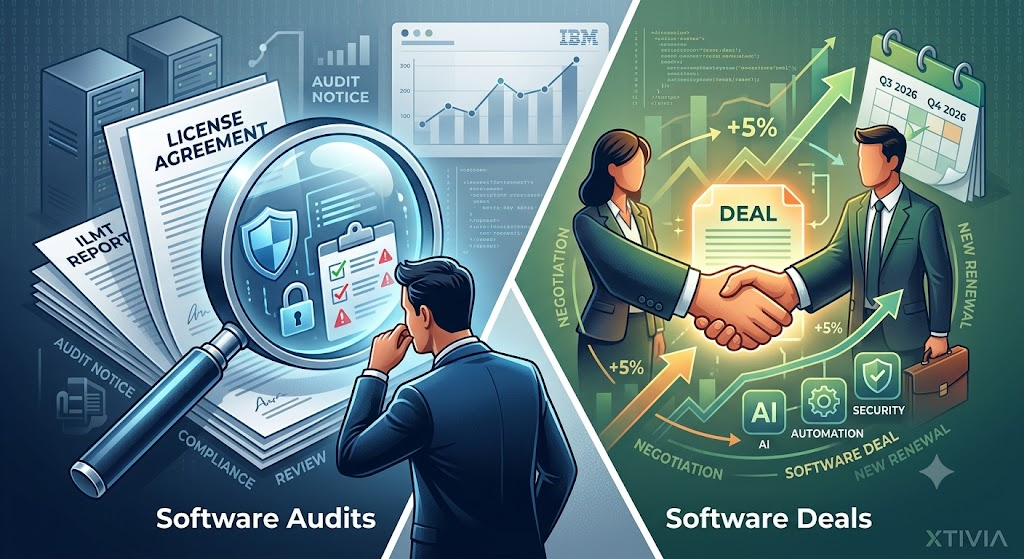
SUMMARY:
Enterprise IT leaders must proactively reconcile software licenses and audit readiness following IBM’s soft second-quarter earnings, which will likely trigger increased compliance audits and aggressive renewal pressure.
Key Takeaways:
- IBM’s Q2 revenue shortfall increases audit risk, as account teams target organizations with flat or declining software spend to compensate for lagging infrastructure sales.
- Internal entitlement reconciliations protect against unfavorable penalties, enabling organizations to establish their own Effective License Position before IBM issues a formal audit notice.
- Strategic deal timing in late 2026 maximizes negotiation leverage, allowing software buyers to secure better pricing and product bundling during high quota pressure in Q3 and Q4.
Technology leaders should partner with independent licensing advisors to audit their software deployments and optimize upcoming vendor negotiations.
Table of contents
IBM’s preliminary Q2 numbers landed light. Revenue came in at $17.2 billion, up 1% year over year, but that headline hides a split story: Software grew 5%, Consulting was flat, and Infrastructure dropped 7% as the z17 mainframe cycle wound down harder and faster than expected. Krishna’s own explanation was that customers redirected capital spending toward servers, storage, and memory ahead of anticipated supply shortages and price increases in late June, and that several large customer contracts weren’t completed within the expected timeframe. The stock didn’t take it well — shares fell sharply the day the preliminary figures went out.
None of that is a crisis for IBM. But for anyone who’s watched this company operate over a few product cycles, a quarter like this usually sets something in motion. When infrastructure sales stall and big deals slip, the machine looks elsewhere to make up the difference — and two of the places it tends to look are software renewals and compliance.
Here’s what I think is coming, and what it means if you’re on the customer side of the table.
Where IBM Goes From Here
IBM rarely responds to a soft quarter with across-the-board discounting. It’s not really built that way. What it does instead is squeeze the levers it already controls.
Software is the obvious one — it’s the segment that’s still growing, so expect account teams to push harder on bundling AI, automation, and security into every renewal conversation, usually dressed up as “modernization.” That’s not new, but the pressure to close those deals goes up when Infrastructure is dragging the topline down.
The less obvious one is compliance. IBM’s license audit program isn’t random — it tends to zero in on contracts that are a few years old with no significant new orders, environments where deployment has clearly outgrown what’s licensed, and accounts where spend has gone flat or declined. A quarter defined by delayed contracts and softer infrastructure spend pushes more customers into exactly that third category. If your organization hasn’t bought much from IBM lately, that alone can look, from IBM’s side, like a reason to take a closer look at what you’re actually running.
And when IBM does talk pricing, it usually isn’t a straight discount — it’s a trade. Convert to a longer Enterprise License Agreement, or move to subscription, and the number moves. The accounts with contracts that stalled this quarter should also expect their reps to come back around quickly; Krishna named those delayed deals directly, which means someone at IBM is already tracking them.
If an Audit Notice Shows Up
The single biggest mistake we see is treating IBM’s first data request as something you just have to comply with as-is. It’s often framed as a “collaborative” review or a License Management Service engagement, but voluntary in name doesn’t mean IBM gets to set the scope, format, and pace unchallenged.
What actually matters is who does the math first. Most compliance findings trace back to gaps in how ILMT was deployed or reported over time, not real overuse — but whoever produces the first Effective License Position sets the anchor for the whole negotiation. If that’s IBM, you’re starting from behind before a single call happens.
So the work worth doing is reconciling entitlements against what’s actually deployed, on your own schedule, before there’s a notice to react to. And it’s worth being deliberate about the story your organization tells if spend has been flat — because IBM’s compliance team reads that as a risk signal on its own. The narrative you want to be telling is “we’ve already checked this,” not “we just stopped buying.”
This is a big part of why we built out XTIVIA’s Software Division the way we did. We’re already inside customer database and software environments day to day, which means entitlement reconciliation and ILMT health checks can happen quietly, on a normal schedule, long before a letter ever shows up. For customers already working with us, that’s just part of how we manage the environment. For anyone else, a pre-audit compliance review is one of the more useful things we do — mainly because it changes who’s in control of the conversation when IBM does come calling.
If You’re Buying New Software
Timing matters more than people think. IBM reps carry quota pressure, and that pressure tends to be higher in the back half of a year that started soft — so Q3 and Q4 2026 are probably better windows for concessions than right now.
Bundling helps too. Discounts show up more often across a multi-product deal — software plus Red Hat plus AI tooling — than on a single line item. And if your compliance position is clean, or you’re over-licensed, that’s worth putting on the table explicitly. Saying you won’t expand the relationship without real pricing relief carries more weight in a quarter where IBM needs the software number to keep looking good.
We spend a lot of time on this side of these deals too — structuring an ELA, timing a renewal so it lands when IBM’s sales team has the most incentive to move, or knowing which products actually bundle for better terms. That’s the value of having someone in your corner who isn’t selling you the product.
Bottom Line
A miss like this doesn’t make IBM friendlier. If anything it points the other way — more audit activity, firmer terms on new deals, and renewed pressure to close whatever stalled this quarter. The organizations that come out ahead are the ones that get their own license position in order now, rather than after a notice arrives. That’s the conversation XTIVIA is built to have with you, on either side of this — audit readiness or your next purchase.