
Summary:
Enterprise IT leaders must establish usage baselines and governance controls before December 3, 2026, as Atlassian transitions Rovo AI features and Automation workflows from flat subscriptions to metered, variable-cost operating expenses.
Key Takeaways:
- Atlassian enforces monthly usage pools for Rovo AI credits and Automation steps: While basic search features remain free, conversational interactions cost 10 credits per message, and advanced agents or automation steps incur variable usage charges once monthly limits are met.
- Overages are enabled by default across a shared organizational pool: Extra usage defaults to active at one cent per credit, allowing high-volume departments or Marketplace apps to exhaust shared allowances and trigger unexpected invoice charges.
- Marketplace apps and automated rules contribute to hidden operating costs: Rovo-enabled third-party apps charge AI consumption directly to the customer’s credit pool, while inefficient Jira Automation scripts accumulate metered step overages.
- Proactive administrative actions prevent unexpected budget overruns: Organizations should audit current consumption, set explicit account spending limits, evaluate Marketplace app efficiency, and consider prepaid credit packs or Teamwork Collection upgrades prior to December 3.
Technology leaders should partner with Atlassian Solutions Partners like XTIVIA to review current usage metrics, configure spending guardrails, and align licensing strategy before consumption-based billing takes effect.
Table of Contents
How the New Model Works
Atlassian now prices AI in tiers. The everyday features are free: Rovo Search inside Atlassian apps, definitions, and summaries don’t use credits. Conversational AI is priced per use. Rovo Chat in Quick Answers mode and basic Rovo agents cost 10 credits per billable event, and in chat, each message you send counts as one event. Advanced work costs more, by a variable amount. That includes Think Deeper mode, advanced agents, agents in Jira, the Jira Coding Agent, and Request Resolver. Atlassian explains that the deeper, broader, or more agentic work Rovo does for you, the more credits it generally uses. Connecting outside AI tools also uses credits. Enriched Teamwork Graph calls, for example, from the Rovo MCP server, mostly cost 1 to 10 credits per call.
Your allowance depends on your products and plan. Standalone Jira and Confluence include 25, 70, or 150 credits per user per month on Standard, Premium, and Enterprise. The Service Collection and Teamwork Collection include 250, 700, or 1,500 credits per user per month, which is ten times as much. Allowances from different products add up. Atlassian’s own example: an organization with 100 Jira Premium users and 100 Confluence Premium users receives 14,000 Rovo credits a month.
The important detail is that the allowance is shared. All of an organization’s allowances go into one pool, so power users can use more and light users less. Your lightest and heaviest users draw from the same balance, and a single team that uses Rovo heavily can use up the pool before other departments have started. Atlassian says the ability to allocate credits by user is coming, but for now the pool is shared.
Overages are on by Default
This is the part most organizations will miss. Atlassian’s documentation says extra usage is turned on by default, and admins can set spending limits or turn it off at any time. The current list price is one cent per Rovo credit, or $10 per 1,000.
With extra usage on, metered features keep working after you reach your allowance. Billing continues until you hit any spending cap the admin has set, and then billable interactions pause until the allowance resets or you buy more credits. The charges appear on your next invoice. Two other rules matter. Unused credits don’t roll over, so a quiet month doesn’t offset a busy one. Prepaid usage packs top up the monthly allowance but also expire if unused. Committed packs, by contrast, are annual prepaid balances that you can draw on flexibly over 12 months.
Atlassian does give you some warning. Admins are notified when consumption reaches 80% and 100% of an included allowance. A notification is useful, but it isn’t a governance plan.
Automation is Changing Too
The same announcement changes Atlassian Automation, and many organizations depend on it more than on Rovo. Every trigger, condition, action, branch, and loop that runs counts as one step. That means a rule that fires and then stops at its first condition still uses steps. Extra usage costs $0.50 per 1,000 steps. Atlassian’s example is that 10,000 steps over the allowance costs $5.00. Enterprise plans are also moving from unlimited Automation to pooled monthly allowances. One workflow can use both meters. Standard triggers and actions consume Automation steps, while Rovo-powered actions draw on the Rovo credit pool.
If extra usage is turned off and you reach 100% of your step allowance, your automations stop running until usage resets on your billing date. If you’ve built dozens of rules over the years without watching their efficiency, now is the time to review them.
What This Looks Like in Practice
Start with Atlassian’s own example organization: 100 Jira Premium users and 100 Confluence Premium users, with 14,000 Rovo credits a month. Assume these are the same 100 people.
Say 40 of them become regular Rovo Chat users and each sends eight Quick Answer messages per workday. At 10 credits per message over 21 workdays, that’s 67,200 credits, nearly five times the allowance. The overage is about 53,000 credits a month. At list price, that’s roughly $530 a month, or about $6,400 a year. And this counts only the cheapest paid tier. Think Deeper, agents in Jira, and other premium features use a variable number of credits per event, so real usage will probably cost more.
The same 100 people on the Teamwork Collection at the Premium level would receive 70,000 credits a month, which covers this scenario. Atlassian itself suggests considering the Teamwork Collection when an organization approaches its allowance. That is why reviewing licensing matters more than managing month-to-month overages.
Automation works the same way. Picture a single Jira Service Management rule that runs eight steps every time a ticket is created, on a service desk that handles 500 tickets a day. That rule alone consumes about 120,000 steps a month. Most mature Atlassian environments have dozens of rules like it. At Atlassian’s rate, an extra two million steps a month adds about $1,000 to the bill.
None of these numbers is alarming by itself. The problem is that none of them appear anywhere until the invoice arrives.
The Marketplace Factor
This change also affects the Marketplace apps you’ve installed, and I think most organizations haven’t considered that yet. Who pays depends on how an app uses Atlassian’s AI.
Apps built as Rovo agents charge their AI costs to you. Atlassian’s developer documentation says Rovo billing happens at the customer organization level, so Marketplace partners don’t pay for their agents’ AI usage. Each agent request uses credits from your pool at the standard rates, whether Atlassian built the agent, your team built it, or it came from a Marketplace app. If an app includes a busy agent, its real cost is its license fee plus the credits it uses.
Apps that call Forge LLMs directly charge the cost to the vendor. Forge LLMs, currently in preview, are metered in credits tied to model tokens and billed to the developer, not to you. You’ll know when an app uses them: admins are notified in the Marketplace listing and at installation, and adding Forge LLMs to an existing app requires a major version upgrade that an admin has to approve.
Here’s what I expect over the next year. This is my view, not anything Atlassian has announced. Admins will start asking which apps use the most credits, and inefficient agents will get turned off. Vendors paying for Forge LLM tokens will face margin pressure, so expect price increases, usage tiers, or apps rebuilt as Rovo agents, which quietly moves the cost into your pool. Apps that mainly duplicate what Rovo already does will find it hard to justify both a license and credit consumption. Customers already want more visibility: one Marketplace partner posted on Atlassian’s developer forum that customers are asking for usage and cost controls inside the app itself.
What we Recommend Doing before December 3rd
First, establish a baseline. In Atlassian Administration, under Insights and then Platform usage, admins can see total allowance, current usage, trends by app and by user, and which features consume credits. For more detail, you can export a CSV of up to three months of Rovo usage, broken down by feature, user, and agent. One caution: AI features still in beta generally don’t count against your allowance today, but they may once they become generally available. Your current baseline may therefore understate future usage.
Second, decide on your overage stance deliberately. Some organizations should leave extra usage on, with a monthly spending cap that matches their tolerance. Others should turn it off so features pause at the limit rather than generate charges. Either choice is reasonable if someone makes it on purpose.
Third, match your licensing to your actual consumption. Atlassian describes three paths for organizations over their allowance: keep extra usage on with spending caps, upgrade to the Teamwork Collection for higher allowances, or buy prepaid usage packs. Annual credit packs come with volume discounts. For sustained heavy use, buying capacity in advance is almost always cheaper than paying list-price overages every month.
Fourth, audit your Marketplace apps. For each installed app, find out whether it uses your Rovo credits, your Automation steps, or neither. Identify any apps that duplicate Rovo features, and include AI consumption in your renewal decisions.
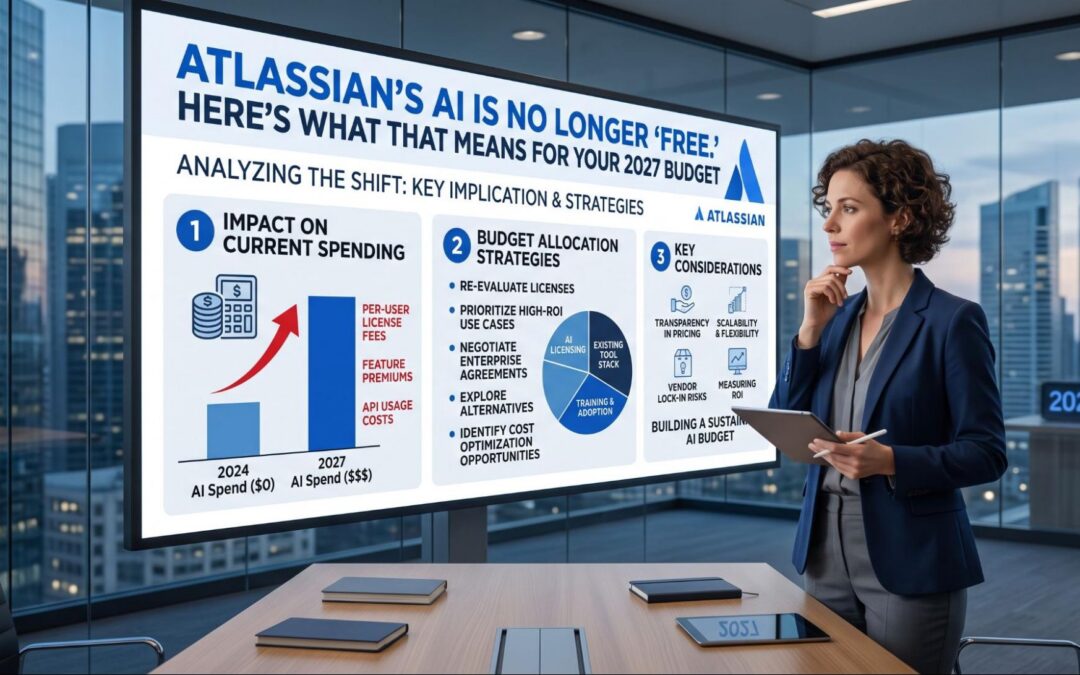
Fifth, budget for AI as a variable line item. If your 2027 budget treats Atlassian as a flat per-seat cost, it’s already outdated. AI agent adoption is growing quickly, and your consumption next year probably won’t look like this year’s.
The bigger picture
I don’t see this as Atlassian doing something unusual. Every major software vendor is working out how to pay for AI inference, and the industry is heading toward consumption-based pricing. The organizations that do well will treat AI usage the way mature teams treat cloud spend, with visibility, guardrails, and regular review.
If you’re an XTIVIA client, or any organization using Rovo and Atlassian Automation, and you aren’t sure what your current consumption looks like, contact us. We’re reviewing usage and Marketplace app portfolios with organizations now, before December 3, so that the first metered invoice doesn’t bring surprises.
Dennis Robinson, President & CEO, XTIVIA
Sources
- Atlassian Support, “How Rovo credits work”: https://support.atlassian.com/rovo/docs/rovo-usage-limits/
- Atlassian Support, “How is your automation usage calculated”: https://support.atlassian.com/cloud-automation/docs/how-is-my-usage-calculated/
- Atlassian Support, “Manage extra usage for a meter”: https://support.atlassian.com/subscriptions-and-billing/docs/manage-extra-usage-for-a-meter/
- Atlassian, “Usage-Based Pricing”: https://www.atlassian.com/resources/usage
- Atlassian Developer, “Forge platform pricing”: https://developer.atlassian.com/platform/forge/forge-platform-pricing/
- Atlassian Developer, “Forge LLMs pricing (Preview)”: https://developer.atlassian.com/platform/forge/runtime-reference/forge-llms-api-pricing/
- Atlassian Developer, “Forge LLMs API”: https://developer.atlassian.com/platform/forge/runtime-reference/forge-llms-api/
- Atlassian Developer Community, “Forge access to customer Platform usage meters (Rovo credits / Automation steps) and extra-usage controls?”: https://community.developer.atlassian.com/t/forge-access-to-customer-platform-usage-meters-rovo-credits-automation-steps-and-extra-usage-controls/102558
- TechRepublic, “Atlassian Will Meter Rovo and Automation Dec. 3: What Admins Need to Budget”: https://www.techrepublic.com/article/news-atlassian-rovo-automation-pricing/