
SUMMARY:
Learn why legacy ITSM slows your business and how Xurrent’s AI-native ESM platform delivers faster, lower-cost service management modernization.
Table of contents
Introduction
Someone recently tossed off a comment that caught my attention:
“Ugh, the ITSM/ESM space is boring. The big players own the market, and it’s just not exciting technology.”
That’s an easy view to hold at first glance. To the outside observer, Enterprise Service Management (ESM) and IT Service Management (ITSM) look like the plumbing of the tech world: ticket queues, approval chains, asset inventories, and routine requests. Nobody writes feature articles about plumbing until the pipes burst.
When companies rush toward modernization to stay agile, capture market share, and innovate, they focus on outward-facing technology. Yet they leave their internal service infrastructure running on legacy platforms.
Ignoring your ITSM/ESM platform during a modernization push is like putting a Formula 1 engine inside a car with a broken transmission.
If your employees and cross-functional teams (IT, HR, Facilities, Finance) are stuck navigating slow, rigid, and overly complex service tools, your entire organization slows down. Modernizing your service stack isn’t boring; it’s a key driver of operational agility.
The Legacy Trap: Why the Giants Aren’t Cutting It
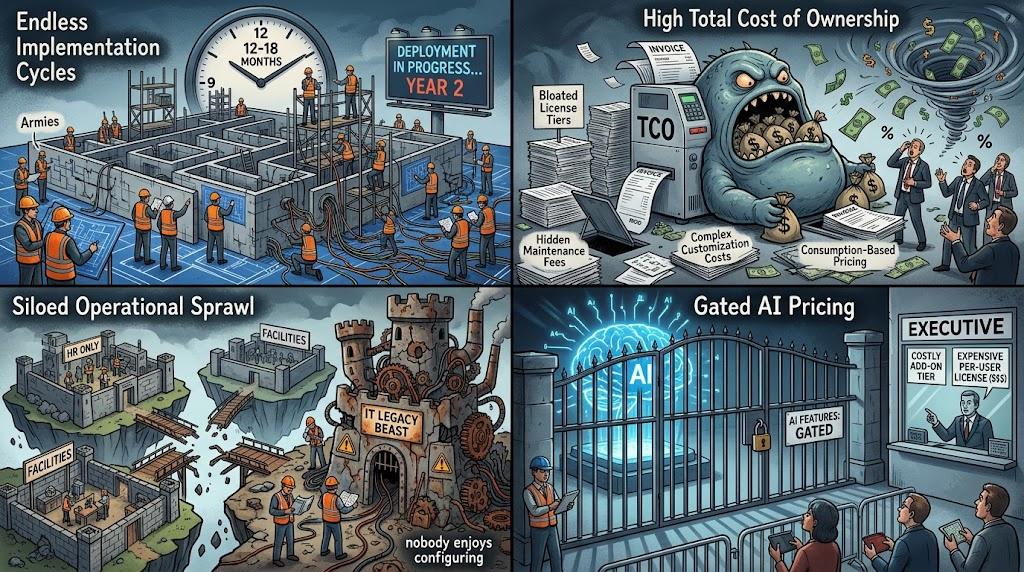
For years, legacy service giants have dominated the market. While powerful, these systems often come with significant burdens:
- Endless Implementation Cycles: Deployments that take 12 to 18 months, requiring armies of specialized consultants.
- High Total Cost of Ownership: Bloated license tiers, hidden maintenance fees, complex customization costs, and consumption-based pricing.
- Siloed Operational Sprawl: HR runs on one tool, Facilities on another, and IT on a legacy beast that nobody enjoys configuring.
- Gated AI Pricing: Treating modern artificial intelligence not as a core feature, but as a costly add-on tier or expensive per-user license.
When service management feels cumbersome, expensive, and slow, people call it “boring.” But the issue isn’t the category; it’s the tools.
Enter Xurrent: Speed, Efficiency, and Modern Design
If you want to modernize quickly without getting bogged down in years of platform maintenance, tools like Xurrent offer a distinct alternative. Built as a multi-tenant, service-first platform, Xurrent simplifies cross-department collaboration while removing administrative overhead.
Here is how a modern platform solves core service management pain points:
1. Unified ITSM and ESM Out-of-the-Box
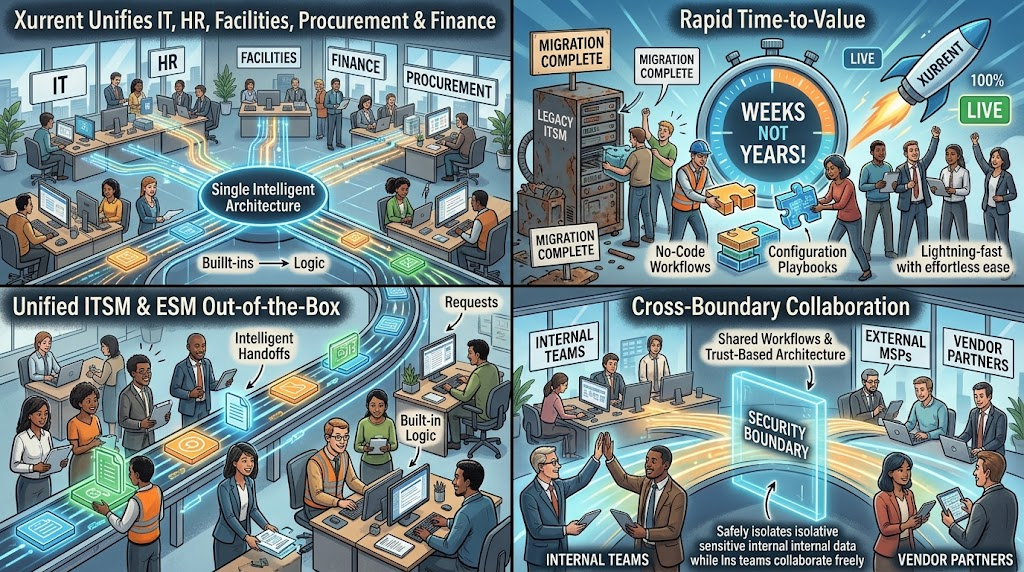
Instead of building isolated silos for different departments, Xurrent unifies IT, HR, Facilities, Procurement, and Finance on a single intelligent architecture. Requests move between departments with built-in logic, dependencies, and handoffs, reducing cross-team delays.
2. Rapid Time-to-Value
Legacy ITSM projects often drag on for months. Modern architectures prioritize fast configuration, low-code/no-code workflows, and rapid deployment playbooks. Organizations can migrate off legacy tools and see results in weeks, not years.
3. Cross-Boundary Collaboration
Modern service management relies on collaboration across internal teams, external managed service providers (MSPs), and vendor partners. Xurrent’s trust-based architecture lets organizations and vendors work in shared workflows without exposing internal security boundaries.
The AI Difference: Native Value vs. Gated Add-Ons
Artificial intelligence highlights the contrast between legacy vendors and modern platforms.
Many legacy platforms package AI behind premium license tiers, custom module add-ons, or consumption-based tax pricing.
Xurrent takes a different approach with Sera AI and its embedded AI fabric:
| Feature | Legacy Platforms | Xurrent (Sera AI) |
|---|---|---|
| Pricing Model | Paid add-ons, higher license tiers, per-interaction costs | Embedded at no extra cost across all platform tiers |
| Architecture | Often bolted-on via acquisitions or separate microservices | Native AI fabric woven into every workflow layer |
| Capabilities | Gated behind premium SKUs | Predictive routing, auto-summaries, auto-generated knowledge, and natural language automation builders out of the box |
| Data Privacy | Complex per-module governance setup | Zero data retention for session calls; secure processing with full permission compliance |
What Sera AI Delivers
Instead of forcing agents to complete tedious administrative work, Sera AI handles background tasks automatically:
- Auto-Classification & Routing: Categorizes incoming tickets and routes them to the right team instantly, reducing misrouted tickets.
- Knowledge Creation: Drafts structured knowledge articles directly from resolved incident contexts for rapid review.
- Plain-Language Automation: Generates workflow automation code from simple natural language prompts.
- Agent Summaries: Condenses multi-page ticket histories into quick updates for faster handoffs.
What Modernization Means to the Client
When you strip away bloated legacy infrastructure and embrace a modern service delivery platform, the business results are straightforward:
- Employees Get Answers Immediately: Intuitive self-service portals, combined with AI virtual agents, resolve Tier-1 issues instantly without human intervention.
- Agents Regain Time: Automating routine routing, drafting, and classification can save service specialists significant weekly bandwidth.
- Predictable Operational Costs: With embedded AI and straightforward licensing models, IT leadership avoids unpredictable add-on fees.
- True Organizational Agility: When HR, IT, and Facilities run on a fast, unified platform, business changes like onboarding, re-orgs, or vendor updates happen in days, not months.
Boring? Far From It.
Calling ITSM “boring” misses the point. Managing services isn’t boring; clunky legacy software is boring.
In a business landscape where agility determines survival, your service delivery engine either accelerates your company or slows it down. Modern platforms like Xurrent prove that service management can be fast, intelligent, and cost-effective without the bloat of traditional tools.
If your organization is pushing to innovate, take a close look at your service desk. Partnering with XTIVI means working with a trusted enterprise technology partner with decades of ITSM expertise. They ensure a seamless migration to Xurrent, empowering your organization to modernize quickly, unlock immediate value, and turn service delivery into a strategic advantage.
Ready to modernize your service management? Contact XTIVIA today to start your move to Xurrent.