
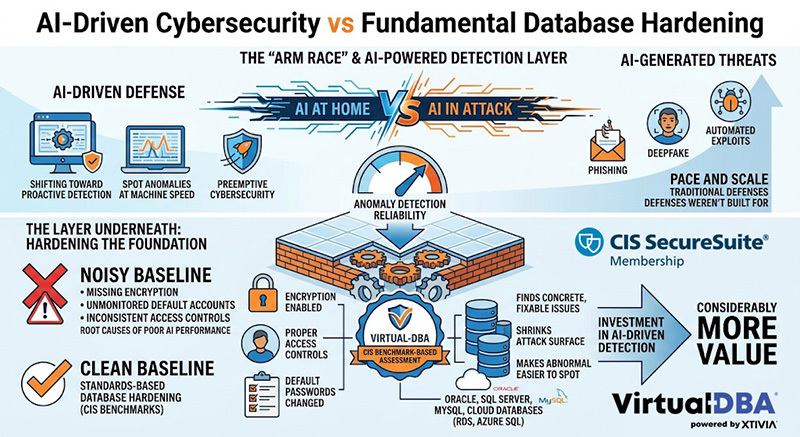
Summary: AI-driven cybersecurity and proactive threat detection are essential for modern defense, but they rely heavily on foundational security hygiene. Without standards-based database hardening—such as CIS Benchmarks—AI threat detection struggles against background noise and misconfigurations. Hardening database security reduces your attack surface and maximizes the return on AI cybersecurity tools.
Table of contents
Cybersecurity in 2026 is increasingly framed as an AI arms race. Attackers are using automation and generative models to scale phishing, create convincing deepfakes, and probe for vulnerabilities at a pace and scale that traditional defenses weren’t built for. Defenders are responding in kind — shifting from reactive, alert-driven security toward AI-powered detection that can spot anomalies and respond at machine speed rather than waiting for a human analyst to notice.
That shift is real and worth paying attention to. But it’s easy to read “AI-driven security” as a replacement for the fundamentals, when it’s actually the opposite: AI-based detection is only as good as the environment it’s watching. If the underlying systems are already full of unmonitored default accounts, missing encryption, and inconsistent access controls, an anomaly-detection model has a much harder job — the “noise” it has to filter out is enormous, and the baseline it’s comparing against is already broken.
Where the Industry Is Headed
The direction is consistent across analysts and vendors: security is moving toward proactive, AI-assisted detection rather than purely reactive response. Gartner has described this shift as preemptive cybersecurity — using AI to identify and block threats before they execute, rather than cleaning up after an incident. On the threat side, a significant share of security teams report that AI-generated attacks — phishing, deepfake impersonation, automated exploit discovery — are their biggest visibility gap right now.
The common thread in nearly every industry writeup on this topic is the same: AI is now operating on both sides of the fight, and organizations that rely on static, periodic security reviews are increasingly outmatched by threats that evolve continuously.
The Layer Underneath the AI Layer
Here’s where the “arms race” framing can be misleading if taken too literally. AI-driven detection tools are pattern-recognition systems — they learn what “normal” looks like for a given environment and flag what deviates from it. That only works well if:
- The environment has a genuinely defined, hardened “normal” to compare against
- Known, well-documented misconfigurations have already been closed
- Access controls, encryption, and account hygiene are consistent enough that anomalies actually stand out
Databases are a particularly common gap here. They hold the data attackers actually want, but general-purpose security audits focused on networks and cloud infrastructure frequently miss vulnerabilities that are specific to databases.
This is where standards-based database hardening — using CIS Benchmarks, a vendor-neutral, industry-recognized set of configuration guidelines developed through a consensus process involving security practitioners and vendors — does work that AI detection tools don’t do on their own. A CIS Benchmark assessment finds concrete, fixable issues: default passwords still enabled, missing encryption, overly permissive access. Closing those gaps doesn’t detect an active attack — it shrinks the attack surface an AI-driven system has to monitor in the first place, and it makes the “abnormal” easier to spot because the baseline is actually clean.
Where XTIVIA Fits
Our Virtual-DBA practice runs CIS Benchmark-based security assessments specifically for databases — including Oracle, MySQL, SQL Server, and cloud-managed platforms like Amazon RDS and Azure SQL — using tools like Oracle’s Database Security Assessment Tool (DBSAT) alongside the CIS Benchmarks themselves. This isn’t AI-driven detection; it’s the hardening and audit layer that sits underneath it. Think of it as the difference between a smoke detector and fireproofing a building — one flags active danger, the other reduces how much there is to catch fire in the first place. Enterprises investing in AI-powered threat detection get considerably more value out of that investment once the databases underneath it are actually hardened against the well-known, well-documented issues a CIS Benchmark assessment is designed to catch.
The Practical Takeaway
AI-driven cybersecurity is a real and important shift, and organizations that ignore it will fall behind attackers who are already using AI to scale their own operations. But it’s not a substitute for configuration hygiene — it’s a capability that performs better when the fundamentals are in place. Before investing further in AI-powered detection and response, it’s worth asking a more basic question: how confident are you that your databases — not just your network and cloud perimeter — have already had a real, standards-based security audit?
Curious what a CIS Benchmark assessment would actually surface in your environment? Virtual-DBA can walk you through a sample report or scope a database security scan.
Sources:
- Gartner Top Strategic Technology Trends for 2026
- eSecurity Planet: AI Threats Outpacing Enterprise Cybersecurity Defenses
- Virtual-DBA: How Oracle DBSAT Helps You Meet CIS Benchmarks with Confidence
- Virtual-DBA: Choosing the Right Oracle Database Security Assessment — CIS, DBSAT, or Data Safe?
- Virtual-DBA: Don’t Let Your Database Be a Blind Spot
- Virtual-DBA: Securing Your Data — The Critical Role of CIS Benchmarks for Database Security