
Last reviewed: September 20, 2026
SUMMARY:
- Since 1 June 2026, production incident support and security updates are paid for every version in Sitecore XP Extended Support.
- XP 10.0 and 10.1 leave Extended Support on 31 December 2026. That is about fifteen weeks away.
- “We are still supported” no longer means what it meant eighteen months ago. Check what you are being charged.
- Five real costs of staying never appear on the renewal invoice. The renewal is the least interesting number here.
- Moving within Sitecore is not an upgrade either. Both paths require a rebuild, which changes the question.
Table of Contents
- Sitecore XP Extended Support: The Dates by Version
- What Changed on 1 June 2026
- Five Sitecore XP Costs That Are Not on Your Renewal
- Sitecore XP Extended Support: Build Your Own Number
- Three Paths Out of Sitecore XP Extended Support
- Before You Shortlist Anything
- What to Do in the Next 30 Days
There is a version of the Sitecore conversation that happens in most organizations running XP. It goes like this: we are still supported, so this is next year’s problem.
That sentence meant something different eighteen months ago. Two things changed, and neither was announced loudly enough for most Sitecore customers to notice.
Sitecore XP Extended Support: The Dates by Version
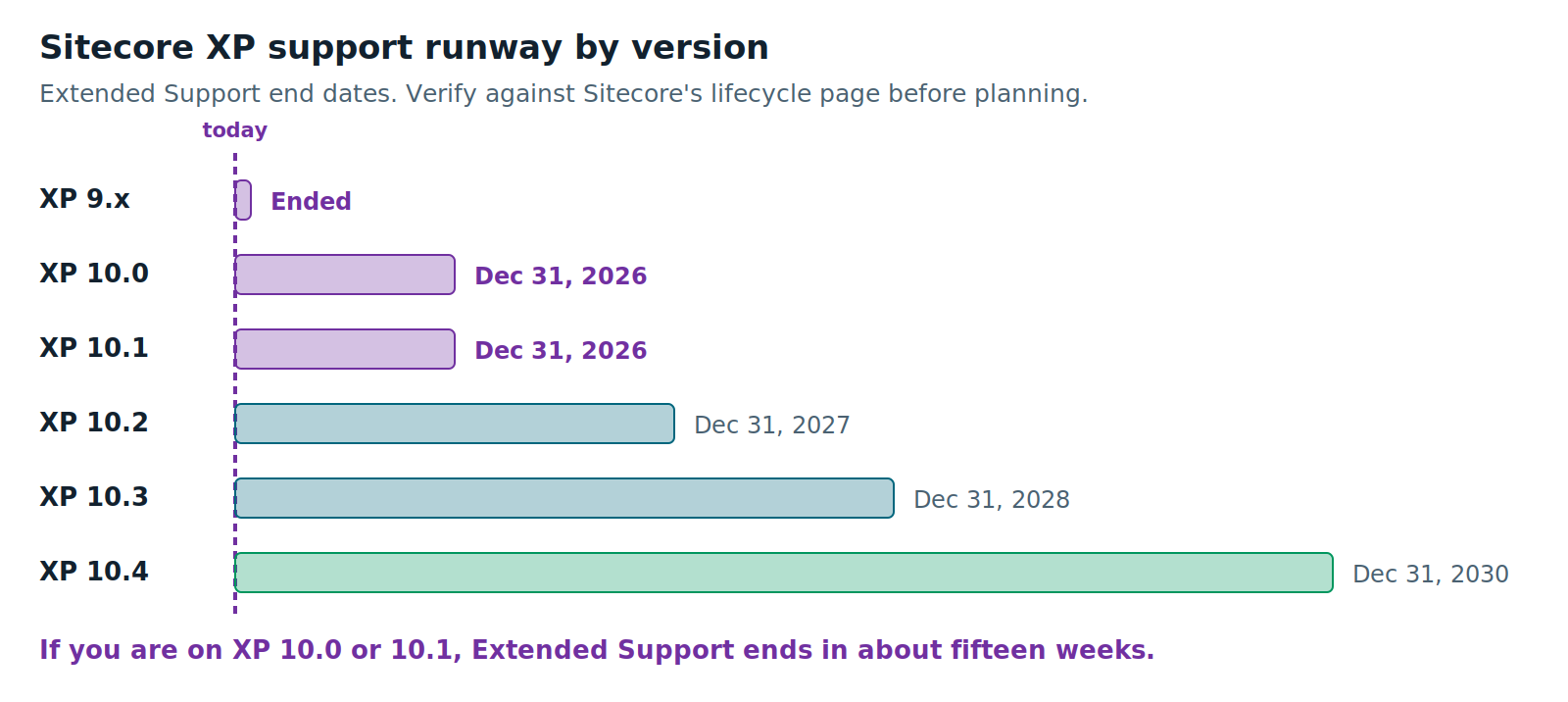
| Version | Mainstream ends | Extended ends | Sustaining ends |
|---|---|---|---|
| XP 9.x | Ended | Dec 31, 2023 – Dec 31, 2025 (by version) | Dec 31, 2025 – Dec 31, 2027 |
| XP 10.0 | Ended | Dec 31, 2026 | Dec 31, 2028 |
| XP 10.1 | Ended | Dec 31, 2026 | Dec 31, 2028 |
| XP 10.2 | Ended | Dec 31, 2027 | Dec 31, 2029 |
| XP 10.3 | Ended Dec 31, 2025 | Dec 31, 2028 | Dec 31, 2030 |
| XP 10.4 | Dec 31, 2027 | Dec 31, 2030 | Dec 31, 2032 |
If you are on 10.0 or 10.1, Extended Support ends in roughly fifteen weeks.
What Changed on 1 June 2026
This is the part most organizations have not absorbed.
Since 1 June 2026, production incident support and security updates are paid for all versions in Extended Support. They used to be included at no extra cost during that phase.
The practical translation: “we are still supported” no longer means what it used to. For much of the Sitecore XP installed base, being supported is now a line item rather than an entitlement.
Whether you are paying it, and how much, is worth asking your account team this week. Several organizations we have spoken to assumed continuity and had not checked.
There is a second, quieter change.
Sitecore’s product investment moved to XM Cloud — now positioned as SitecoreAI — several years ago. XP has been in maintenance longer than its support calendar suggests.
Support dates tell you when a vendor stops answering the phone. They do not tell you when the vendor stopped building. That date usually comes first.
Five Sitecore XP Costs That Are Not on Your Renewal
The renewal invoice is the number everyone looks at. It is the least interesting number in this decision.
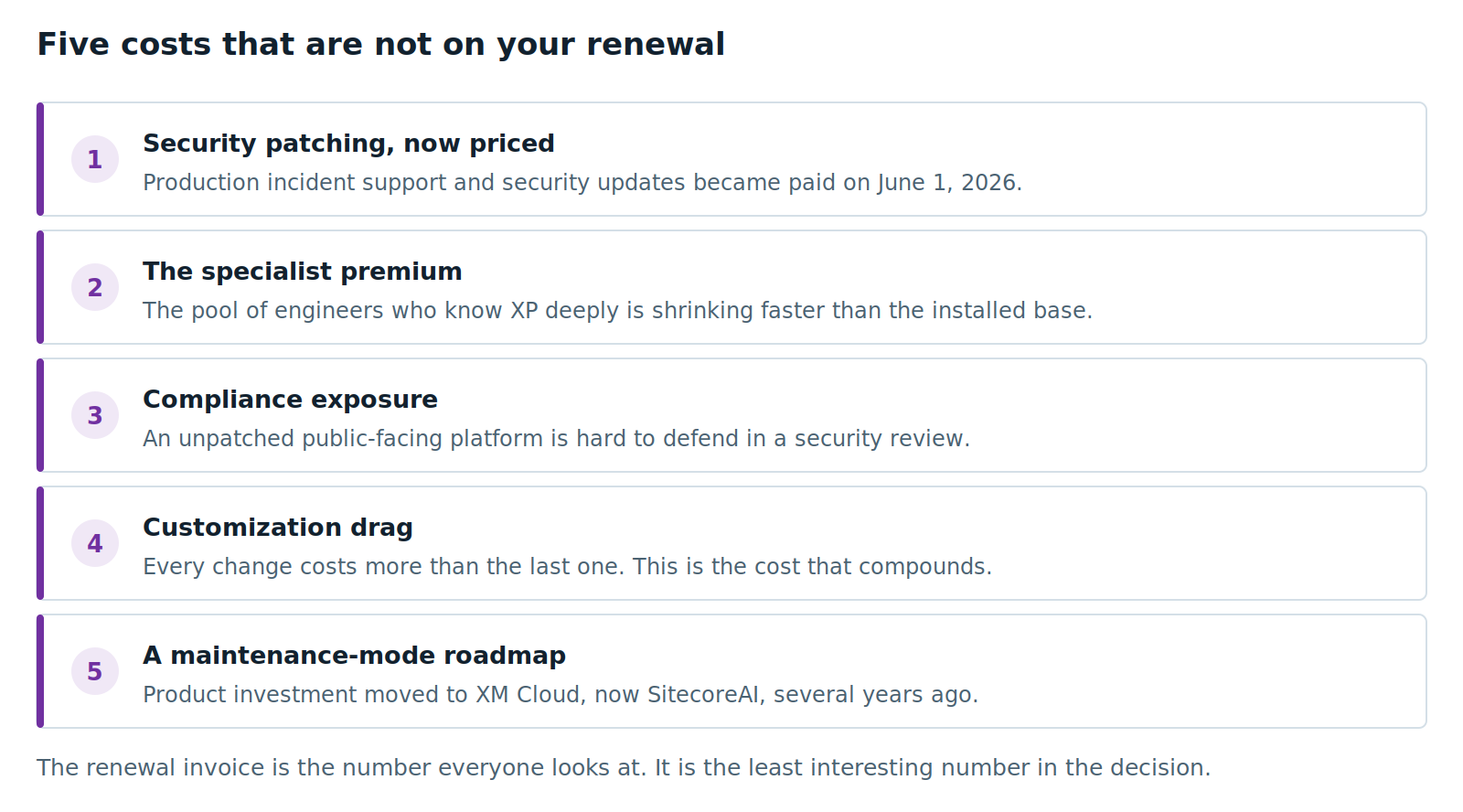
1. Security patching, now priced. Staying current on a platform facing the public internet has moved from bundled to billed. Model it explicitly. If nobody has quoted you, you do not yet know this number.
2. The specialist premium. The pool of engineers who know Sitecore XP deeply is shrinking, and faster than the installed base is. It shows up first as longer time-to-hire, then as contractor rates, then as risk when the one person who understands your implementation leaves. It appears on no purchase order.
3. Compliance exposure. An unpatched public-facing platform is increasingly hard to defend in a security review. In regulated sectors it becomes a finding rather than a preference. Ask your CISO how they would describe your current posture in an audit. That answer often moves the timeline more than any cost model.
4. Customization drag. Long-lived XP implementations accumulate custom code, and that code makes every change more expensive than the last. This is the cost that compounds. It is why “we will deal with it next year” has been getting more expensive every year you have said it.
5. A maintenance-mode roadmap. Whatever your competitors are doing with content, personalization and AI-era discoverability, you are doing it on a platform whose roadmap attention went elsewhere. Hardest to quantify. Frequently the largest.
Sitecore XP Extended Support: Build Your Own Number
Do not take our framing for it. Run this against your own environment. It takes about an hour with the right two people in the room.
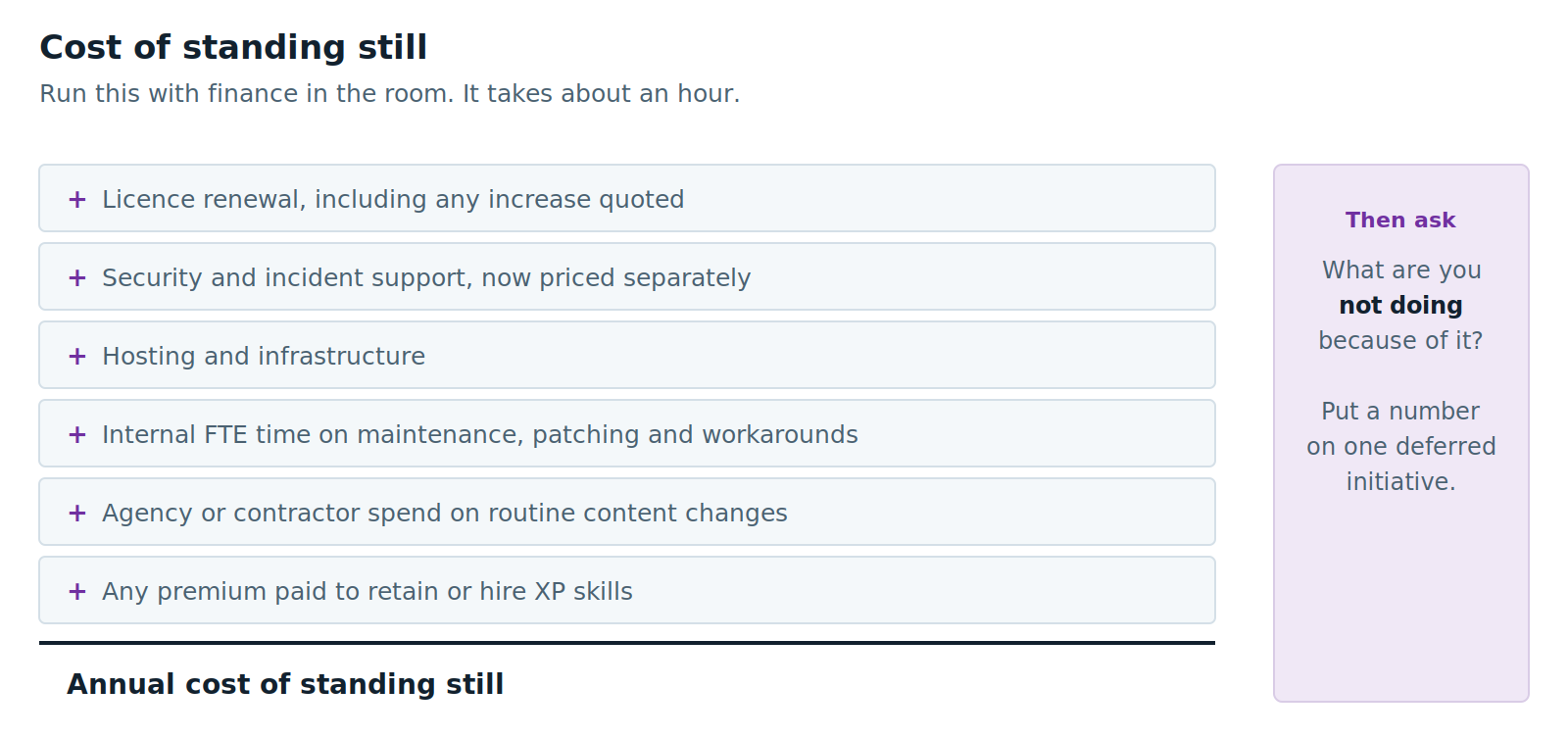
  License renewal, including any increase you have been quoted
+ Security and incident support, now priced separately
+ Hosting and infrastructure
+ Internal FTE time on maintenance, patching and workarounds
+ Agency or contractor spend on routine content and config changes
+ Any premium you pay to retain or hire XP skills
= Annual cost of standing still
Then two questions the number alone will not answer.
What are you not doing because of it? Count the initiatives deferred, the channels not launched, the campaigns that shipped late. Put a revenue figure against one of them. Just one, the clearest. See how it compares.
What happens at the end of Sustaining Support? Every version on that table has a terminal date. The decision is not whether to move. It is whether you move on a schedule you choose or one you inherit.
Three Paths Out of Sitecore XP Extended Support
Stay on XP for now. Legitimate in a narrow set of cases: a real capital constraint this fiscal year, a major business event that makes platform work impossible, or a version with genuine runway where the cost of staying is low.
It is a deferral. Make it an explicit, dated, owned decision rather than a default. Write down when you will revisit it.
Move within the Sitecore ecosystem. XM Cloud is SaaS with no version lifecycle to manage, and it is where Sitecore is investing. If your team has deep Sitecore skills, if you have real investment in Sitecore Personalize or Sitecore Search, or if your marketing operation is built around Sitecore’s model, this keeps knowledge you have already paid for.
One thing to be clear about: this is not an upgrade. Templates, integrations and customizations need substantial rework. The effort is closer to a replatform than a version bump. Organizations that budget for the latter discover this around month four.
Replatform to something else. This is the option we implement, so weigh our view accordingly.
The argument is not that Sitecore is bad. It is that once both paths require a rebuild, the question changes.
If you are rebuilding either way, the honest question is not “how do we stay on Sitecore with the least disruption.” It is “what is the right foundation for the next seven years, given what we now know about how we actually work?”
Some organizations answer that with Sitecore. Many answer differently once the question is put that way.
Before You Shortlist Anything
One piece of sequencing advice, wherever you land.
Most Sitecore XP implementations do two jobs. They publish marketing content to the public, and they serve something to people who log in.
Those are different problems with different right answers. A shortlist built before you know which one dominates is a shortlist for the wrong project.
We wrote a short diagnostic for working that out: are you replacing a CMS or a platform? It takes ten minutes and it will change your shortlist more than any feature comparison.
What to Do in the Next 30 Days
1. Confirm your version and support status in writing — including what production incident support and security updates now cost you.
2. Ask your account team for the three-year renewal picture, not just the next one. You are making a multi-year decision and you need multi-year numbers.
3. Run the cost-of-staying calculation with finance in the room.
4. Establish your content operation baseline — time from request to live, share of changes needing a developer. You will need it to justify any direction.
5. Name the decision owner and the decision date. Fifteen weeks is enough time to decide well. It is not enough to drift.
Further Reading
- Sitecore’s product strategy for XP — Sitecore’s own position, worth reading directly
- Americaneagle.com’s Sitecore version and support lifecycle reference — a well-maintained partner summary of the lifecycle table
- Liferay’s comparison against Sitecore — a competitor’s view, useful mainly for where it concedes ground
- Contentful’s guide to content migration planning — vendor perspective, sound sequencing advice
XTIVIA has implemented enterprise content and portal platforms for over twenty years. We are a Liferay Platinum Partner and a Contentful partner, and we do not implement Sitecore — worth knowing when you read our view on it. The dates above come from Sitecore’s published lifecycle; verify them at source before building a plan. Get in touch if you want a second set of eyes on your cost model.