
Summary: The Liferay Data Platform (LDP) unifies customer and account data natively within Liferay DXP, bridging the gap between behavioral analytics and real-time activation. This first look explores LDP’s key capabilities—including unified profiles, real-time segmentation, and account-based lifecycle tracking—explaining how B2B marketing and sales teams can use it to eliminate data silos and improve personalized customer experiences.
Table of contents
- What Is Liferay Data Platform?
- The Problem Liferay Data Platform Is Built to Solve
- Inside Liferay Data Platform: Key Capabilities
- What’s Live Today, and What’s Coming Next
- How Liferay Data Platform Fits Into Liferay DXP
- Who Should Care About Liferay Data Platform
- Frequently Asked Questions About Liferay Data Platform
- Final Thoughts
Most B2B marketing and sales teams already know the problem even if they’ve never used the term “customer data platform” to describe it. Customer information lives in a CRM. Behavioral data lives somewhere else, usually a web analytics tool. Campaign performance lives in a marketing automation platform. Account intelligence lives in an ABM tool. None of these systems talk to each other in real time, and the result is slow, manual segmentation, weak personalization, and a Marketing and Sales team that are technically looking at the same customer but seeing two different pictures.
Liferay is tackling that problem directly with Liferay Data Platform, a newly launched capability that unifies customer and account data natively inside Liferay DXP. This post is a first look at what Liferay Data Platform actually does, what’s available today, and what’s still rolling out over the next few release cycles.
What Is Liferay Data Platform?
Liferay Data Platform, often shortened to LDP, is described by Liferay as a unified, privacy-aware engine designed to bridge the gap between behavioral analytics and real-time activation. It ships as its own standalone SaaS product, so technically it doesn’t require Liferay DXP to run. In practice, that’s not really the point: LDP’s real value comes from pairing it with Liferay DXP, which is what turns unified account profiles into the real-time segments and personalized experiences that make the platform worth adopting in the first place. Running it without DXP gets you data unification, but not the activation layer that’s the actual payoff.
Liferay Data Platform represents an evolution of Liferay Analytics Cloud rather than a completely new product built from scratch. That matters, because it means Liferay is extending a data and analytics foundation many Liferay DXP customers already use, rather than asking them to adopt an entirely unfamiliar system.
It’s worth being clear about what LDP is not. This isn’t a general-purpose, horizontal customer data platform meant to replace an enterprise-wide CDP or a full marketing cloud, and it isn’t built around a data-warehouse model. It’s purpose-built for B2B organizations running connected, account-based buying journeys on Liferay DXP, typically ones that already have a CRM and a campaign or ABM tool in place and want those systems connected to DXP, not replaced by another platform.
The Problem Liferay Data Platform Is Built to Solve
Before getting into features, it helps to name the specific pain points LDP is aimed at, since they’ll sound familiar to almost any B2B marketing or RevOps team:
- No single source of truth. Customer data lives in disconnected systems with no reliable way to reconcile conflicting records, so Marketing, Sales, and RevOps end up working from different pictures of the same account.
- Slow, manual segmentation. Building a timely, meaningful segment means exporting lists and stitching them together by hand, instead of something that updates automatically as customer behavior changes.
- Personalization that can’t scale. Without unified profiles and behavioral context, real-time personalization stays limited to broad, generic messaging rather than anything account-specific.
- Marketing and Sales working from different truths. Inconsistent versions of the same account data turn coordinating journeys, follow-up, and activation into a constant exercise in reconciling spreadsheets and conflicting reports.
These aren’t abstract concerns either. Forrester research shows 86% of B2B purchases stall at some point in the buying journey, often invisibly, since an account can stay outwardly ‘active,’ opening emails, browsing pages, without actually advancing. And in a KPMG survey, 92% of executives called well-constructed data products critical to their organization’s success, but only 35% said their initiatives had actually generated extensive value, which suggests the fix usually isn’t another tool, it’s connecting the ones already in place.
Liferay Data Platform is built to close each of those gaps at once, by giving every team a shared, continuously updated view of the customer.
Inside Liferay Data Platform: Key Capabilities
Unified customer and account profiles. LDP consolidates data points like device IDs, cookies, and CRM organizational IDs into a single account or customer profile, connecting data from Liferay DXP, CRM systems, and other marketing tools into what Liferay describes as a complete 360-degree identity. Instead of three teams working from three different records, everyone works from one.
Real-time, rule-based segmentation. Rather than exporting lists and rebuilding segments by hand every time a campaign changes, LDP creates dynamic, reusable segments that update instantly based on customer behavior and profile attributes. As new events and external data arrive, profiles stay current automatically.
Event-to-context transformation. LDP turns raw user events into derived attributes, building segments based on a combination of behavior and CRM context. That means a segment isn’t just “everyone who visited the pricing page,” it can be “high-value accounts, already engaged with Sales, who just returned to the pricing page,” all built from continuously updating profile data.
Cross-channel audience activation. Once a segment is defined, LDP can trigger personalized content, campaigns, and workflows based on user behavior or intent, including personalized website experiences tailored specifically to high-value target accounts and automated campaigns triggered the moment a user enters a defined segment.
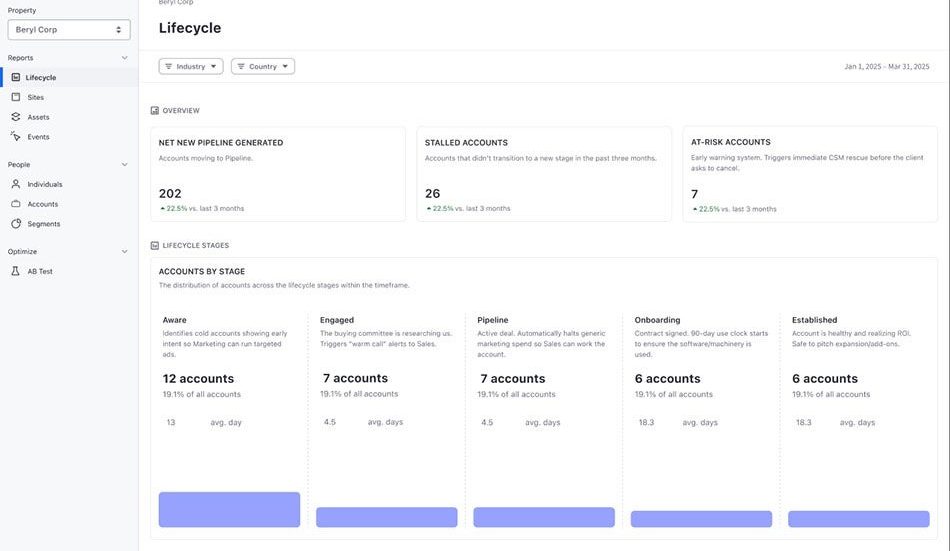
Account Lifecycle Dashboard. LDP tracks each account through its lifecycle stages, from initial awareness to an established, expansion-ready customer, and flags accounts that have stalled or turned at-risk along the way, giving Marketing, Sales, and RevOps a shared dashboard for prioritizing based on momentum and conversion signals rather than fragmented, team-specific reporting. Each account is tracked at its high-water mark, so it always reflects the most advanced stage it has reached.
Support for account-based, multi-stakeholder journeys. Because B2B buying decisions rarely involve just one person, LDP is built to support account-based journeys involving multiple stakeholders, enabling coordinated marketing and sales activation across an entire buying committee rather than a single contact.
What’s Live Today, and What’s Coming Next
One thing worth being upfront about: not every piece of Liferay Data Platform is available on day one, and Liferay itself has been transparent about a phased rollout. Today, LDP ships with prebuilt connectors for Salesforce, Marketo, and Demandbase, along with unified profile views and real-time personalization when paired with Liferay DXP. Liferay has also signaled a broader connector framework is on the way for organizations running other marketing stacks, along with deeper campaign activation features and commerce event ingestion further down the road. Because the connector list is actively expanding right around launch, it’s worth checking Liferay’s current capabilities page for the latest specifics before finalizing a rollout plan around a particular CRM or marketing tool.
For organizations evaluating LDP now, that means the core value, unified profiles and real-time personalization, is real and usable today, and teams running Salesforce, Marketo, or Demandbase get full connector support right out of the gate. Organizations on other CRM or marketing automation platforms should plan around the near-term roadmap rather than assuming day-one support, since the connector list is still expanding beyond this initial set.
It’s worth building an evaluation timeline around this phase rather than treating LDP as an all-or-nothing decision. A Salesforce, Marketo, or Demandbase-connected organization can realistically start unifying account data and activating real-time personalization this quarter, while teams on other platforms may want to pilot the platform’s profile and segmentation capabilities now and plan full connector-driven automation once broader connectivity lands. Either way, waiting for every roadmap item to ship before getting started means leaving real, usable capability on the table.
How Liferay Data Platform Fits Into Liferay DXP
The biggest structural difference between LDP and a typical customer data platform isn’t that it’s embedded in Liferay DXP’s codebase, it’s a standalone product, as covered above. The difference is how tightly the two are designed to work together. Segments and profiles built in LDP can immediately drive personalized content, layout changes, and calls to action inside a live Liferay DXP site, without exporting data to a separate activation tool or waiting on a developer to wire up an integration. For organizations that have already built their digital experience on Liferay DXP, that’s a meaningfully shorter path from ‘we have a segment’ to ‘our website is already responding to it’.
Getting the full benefit of that hand-off assumes a reasonably current DXP implementation underneath it. If your instance is overdue for a Liferay DXP upgrade, that’s worth doing alongside (or ahead of) an LDP rollout, so the personalization and activation features have a current platform to plug into.
Who Should Care About Liferay Data Platform
The clearest fit is any B2B organization already running Liferay DXP that’s struggling with the classic symptoms of fragmented customer data: Marketing and Sales working from different account pictures, personalization efforts that take days to update instead of happening in real time, or account-based marketing programs that are more manual than automated. Organizations running account-based motions with multiple stakeholders per deal are especially well positioned to benefit from the Account Lifecycle Dashboard and multi-stakeholder journey support. And because LDP builds on Liferay Analytics Cloud rather than replacing it outright, current Analytics Cloud customers have a natural upgrade path worth exploring sooner rather than later.
Marketing operations and RevOps teams in particular stand to gain the most in the short term, since they’re usually the ones stitching together spreadsheets and manual exports just to get a shared view of account activity. Handing that reconciliation work to a platform that updates itself in real time frees those teams up to spend their time on strategy and campaign design instead of data cleanup.
LDP is a weaker fit for organizations looking for a standalone, enterprise-wide CDP, a warehouse-native data model, or a hub that pushes coordinated actions out to email, ads, and other channels that live entirely outside a Liferay DXP-powered experience. If that’s the actual requirement, a different category of platform is probably the better starting point. LDP’s value is specifically in connecting the CRM and campaign tools you already run into the Liferay DXP experiences you already own, not in replacing any of them.
Frequently Asked Questions About Liferay Data Platform
Is Liferay Data Platform a CDP? It does the core job of a customer data platform, unifying customer and account data into a single profile, but it is purpose-built for B2B, account-based journeys on Liferay DXP rather than a general-purpose, warehouse-native enterprise CDP. Think of it as a DXP-native CDP layer, not a replacement for a horizontal CDP.
Does Liferay Data Platform require Liferay DXP? LDP’s value comes from pairing it with Liferay DXP, which provides the real-time activation layer. On its own it can unify data, but the payoff, turning segments into live, on-site personalized experiences, depends on Liferay DXP.
Is Liferay Data Platform the same as Liferay Analytics Cloud? No. LDP is an evolution of Liferay Analytics Cloud, extending that analytics foundation with unified account profiles, real-time segmentation, and activation. Existing Analytics Cloud customers have a natural upgrade path.
Which connectors does Liferay Data Platform support? At launch, LDP ships with prebuilt connectors for leading CRM, marketing automation, and ABM tools, with a broader connector framework, deeper campaign activation, and commerce event ingestion rolling out over coming release cycles.
What is live today versus coming next? Unified customer and account profiles, real-time rule-based segmentation, and cross-channel activation with Liferay DXP are live today. A broader connector framework and deeper activation features are on the near-term roadmap.
Final Thoughts
Liferay Data Platform is a genuinely significant addition to the Liferay ecosystem, not because unifying customer data is a new idea, but because Liferay is solving it natively inside the platform teams are already using to run their digital experience. The core capabilities, unified profiles, real-time segmentation, and cross-channel activation, are live now, while the connector ecosystem continues to expand over the next several release cycles.
For organizations already invested in Liferay DXP, this is worth a serious look sooner rather than later, especially if fragmented customer data has been quietly limiting how personalized and coordinated your marketing and sales efforts can actually be.
If you want to go deeper, Liferay has published two useful companion resources: 12 questions to ask before your next data project, a planning checklist worth running through before any LDP rollout, and the stalled account playbook, which digs into exactly the kind of quiet, invisible account stalls LDP’s lifecycle dashboard is built to catch.
At XTIVIA, we help organizations get the most out of their Liferay DXP investment, including evaluating and implementing new capabilities like Liferay Data Platform. Our team of Liferay DXP experts can help you assess whether LDP fits your current marketing and sales stack, plan a rollout around the connectors you actually need, and turn unified customer data into real, measurable personalization.
Contact XTIVIA today to talk through your Liferay Data Platform evaluation and the rest of your digital experience strategy. Let’s put your customer data to work.