
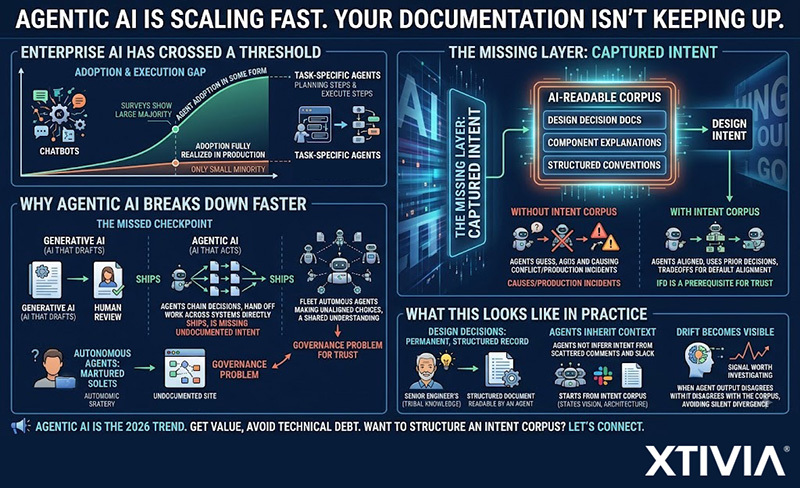
Summary: While enterprise adoption of Agentic AI is accelerating rapidly, the true bottleneck isn’t the technology itself — it’s the lack of structured, machine-readable documentation of design intent. Without this crucial foundation, autonomous agents risk making uninformed decisions that compound technical debt. Intent-First Development (IFD) serves as the necessary captured-intent infrastructure, ensuring AI agents understand, respect, and align with core architectural constraints before taking action.
Table of contents
Enterprise AI has crossed a threshold. The conversation has moved past chatbots and copilots into something more consequential: systems that plan, decide, and execute multi-step work with minimal human intervention. Analysts now expect a large share of enterprise applications to embed task-specific AI agents within the next year or two, up from a tiny fraction just a couple of years ago. The shift from “AI that drafts” to “AI that acts” is no longer a roadmap item — it’s happening in production environments right now.
But adoption and execution are not the same thing. Recent industry surveys show a wide gap between enterprises that have deployed agentic AI in some form and those actually running it reliably in production — with a large majority reporting they’ve adopted agents at some level, but only a small fraction saying that adoption is fully realized in day-to-day operations. That gap is the story underneath the headline stat. It’s not a tooling problem. It’s an intent problem.
Why Agentic AI Breaks Down Faster Than Generative AI Did
When AI simply drafts a document or writes a function, a human still reviews the output before it ships. Agentic AI removes that checkpoint by design — that’s the entire value proposition. An agent chains decisions, calls tools, and hands off work across systems without waiting for someone to approve each step.
That’s powerful. It’s also exactly why undocumented intent becomes dangerous at scale. A single AI-assisted pull request with unclear rationale is a code review problem. A fleet of autonomous agents making architectural decisions without a shared understanding of why the system is built the way it is — that’s a governance problem, and it compounds every day it goes unaddressed.
This is the same failure mode we’ve written about extensively in our Intent-First Development series: AI has decoupled the speed of producing output from the speed of deciding what should be built and why. Generative AI made that gap uncomfortable. Agentic AI makes it structural.
The Missing Layer: Captured Intent
Intent-First Development (IFD) is XTIVIA’s methodology for bringing architectural intent, design decisions, and institutional knowledge into every AI-generated line of code — and it was built for exactly this moment. The core inversion is simple: design intent is captured before implementation begins, in a structured, AI-readable corpus, and that corpus is what every subsequent AI session — human-prompted or agent-driven — reads from before it acts.
That distinction matters more as autonomy increases. Consider the two paths:
Without a captured-intent corpus: An agent encounters an ambiguous requirement, a missing constraint, or a legacy pattern it doesn’t understand. It guesses. The guess ships. Nobody notices until the guess conflicts with a decision made three sprints ago in a different part of the system — decisions that were never written down, so there’s nothing for the agent (or the next engineer) to check against.
With a captured-intent corpus: The agent reads the relevant Design Decision Documents, component explanations, and structured convention files before generating anything. It knows what was already decided, what tradeoffs were considered, and what constraints are non-negotiable. The output is aligned by default, not by luck.
This is why we’d argue IFD isn’t a “nice to have” layered on top of agentic AI adoption — it’s a prerequisite for doing agentic AI safely at scale. Gartner projects that a large share of enterprise applications will embed task-specific agents within the next year or two, up from a small fraction just a couple of years ago. Separately, surveys of enterprises already running agentic pilots show most have adopted agents in some form, but only a small minority describe that adoption as fully realized in production. Different studies, different measures — but the pattern across both is consistent: the bottleneck isn’t building agents, it’s trusting what they do once they’re autonomous. That’s an intent gap, not a technology gap.
What This Looks Like in Practice
For teams already running (or piloting) agentic workflows, the practical shift looks like this:
- Design decisions leave a permanent, structured record — not tribal knowledge that lives in one senior engineer’s head, but a document an agent can actually read and reason against.
- Agents inherit context instead of reconstructing it. Instead of an agent inferring intent from scattered code comments and Slack threads, it starts from a corpus that already states the vision, the architecture, and the reasoning behind prior choices.
- Drift becomes visible. When an agent’s output disagrees with the corpus, that’s a signal worth investigating — not a silent divergence that surfaces six months later as a production incident.
None of this requires abandoning your current AI tooling or agent framework. IFD is a methodology, not a product — it works whether your agents run on Claude, Copilot, or a custom orchestration layer, because the discipline sits above the tool.
The Bottom Line
Agentic AI is the trend every enterprise is racing toward in 2026. The organizations that will actually get value out of it — rather than accumulating autonomous technical debt at agent speed — are the ones treating captured intent as infrastructure, not paperwork. If your agents are moving faster than your documentation, the documentation is the bottleneck you should be fixing first.
Want to talk through what an intent corpus would look like for your existing systems, or how to structure one before a greenfield agentic project kicks off? Let’s connect. (link to Nir Calendar)
Sources:
- Gartner Top 10 Strategic Technology Trends for 2026
- CloudKeeper: Top Agentic AI Trends to Watch in 2026
- Svitla: Agentic AI Market Trends 2026
- XTIVIA: Introduction to Intent-First Development
- XTIVIA: Why Intent Matters More Than Code
- XTIVIA: Intent-First Development for Engineering Managers and Directors