
SUMMARY:
- XTIVIA implements both Contentful and Liferay, so we publish the rule we use rather than asking you to trust us.
- The rule: Contentful when the constraint is content velocity, Liferay when it is integration and entitlement.
- Neither vendor disputes this. Each publishes roughly the same split about itself.
- Three conditions override the rule, and there is a third path that uses neither product: a custom portal.
- Sometimes the answer is both platforms. Sometimes it is neither, and we will say so.
Table of Contents
- Why We Are Publishing Our Contentful vs Liferay Rule
- The Contentful vs Liferay Rule, in One Line
- Five Questions Behind the Contentful vs Liferay Decision
- Where the Contentful vs Liferay Rule Breaks
- The Third Path We Have to Mention
- When the Answer Is Both
- When We Recommend Neither
- How to Hold Us to This
Why We Are Publishing Our Contentful vs Liferay Rule
XTIVIA implements both Contentful and Liferay. We have been a Liferay partner since 2008 and a Platinum Partner since 2011. Our Contentful practice is built around structured content and modern front ends.
That raises a fair question from everyone we talk to: how do we know you will recommend the right one rather than the convenient one?
You cannot know it from a promise. So here is the rule instead. Judge it, argue with it, hold us to it.
The Contentful vs Liferay Rule, in One Line
Contentful when the constraint is content velocity. Liferay when the constraint is integration and entitlement.
That is the whole thing. Everything below is elaboration.
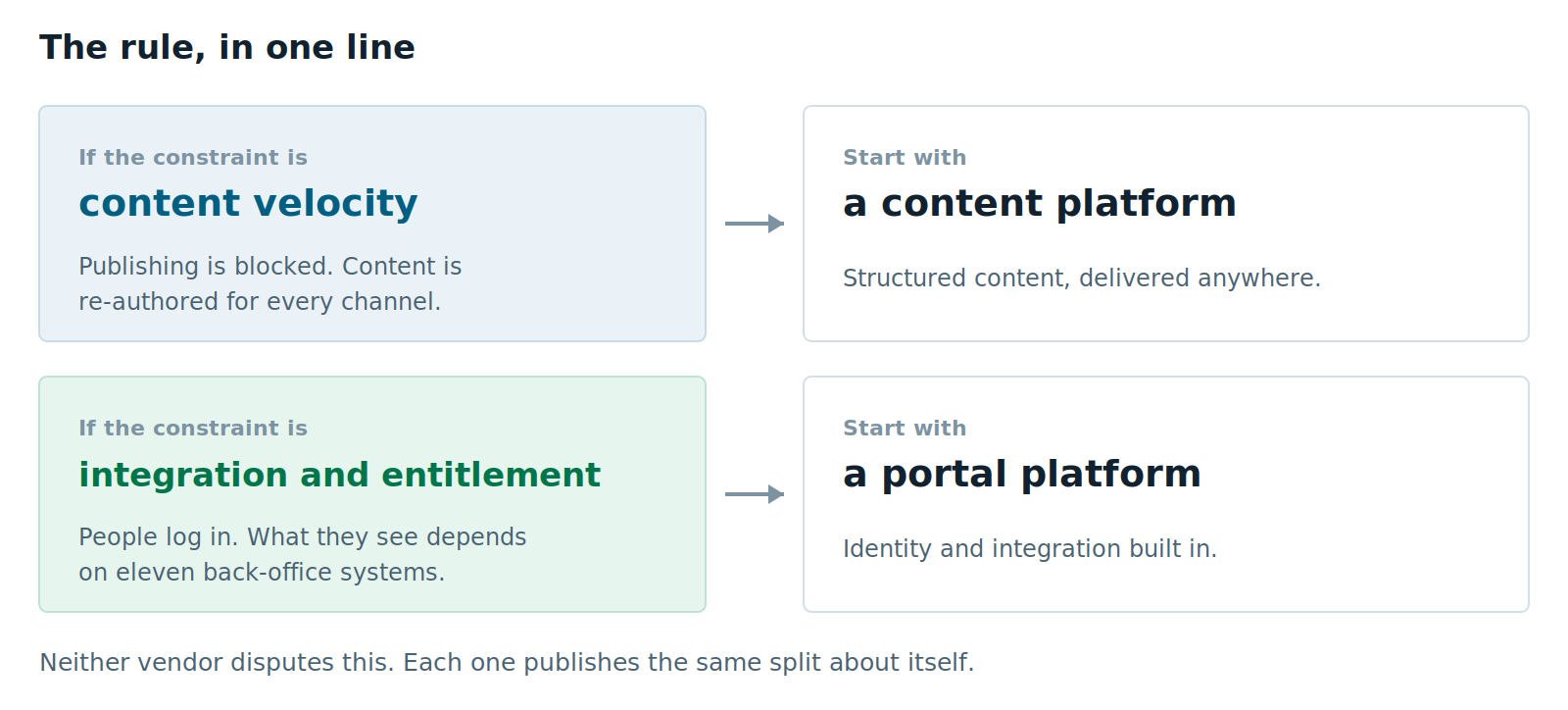
If your problem is that the organization cannot publish fast enough — content stuck behind developer queues, the same material re-authored for every market, a mobile app that cannot reach the website’s content — the constraint is content velocity. A composable content platform addresses it directly.
If people log in and what they see depends on who they are and on what eleven back-office systems say — customer portals, dealer and broker portals, provider and supplier portals, intranets, member self-service — the constraint is integration and entitlement. A digital experience platform built for portals addresses it directly.
Neither vendor disputes this.
Liferay’s own comparison pages claim authenticated enterprise workloads and concede marketing-led personalization to others. Contentful’s material claims content velocity and omnichannel delivery.
We did not invent a split to justify selling both. We adopted the one each vendor publishes about itself.
Five Questions Behind the Contentful vs Liferay Decision
We work through these in the first discovery conversation, before any product comes up.
- What share of the experience sits behind a login? Under 20% points to content. Over 50% points to platform.
- When content changes, what has to happen? “Someone edits it” is a velocity problem. “We verify entitlements and check the ERP feed” is an integration problem.
- How many systems does the experience read from in real time? If you connect to zero to two systems, content delivery is typically the primary driver — though even a single integration can occasionally push you toward an integration-led setup. Five or more, and integration architecture dominates.
- Whose life gets worse if this fails? A marketing director who cannot ship campaigns is a different project from an operations lead buried in calls a portal should deflect.
- What would you measure a year later? Publish cycle time and content reuse, or call deflection and portals consolidated.
The longer version of this diagnostic, with the reasoning behind each question, is here.
Where the Contentful vs Liferay Rule Breaks
This is the part that matters. A rule with no exceptions is a price list.
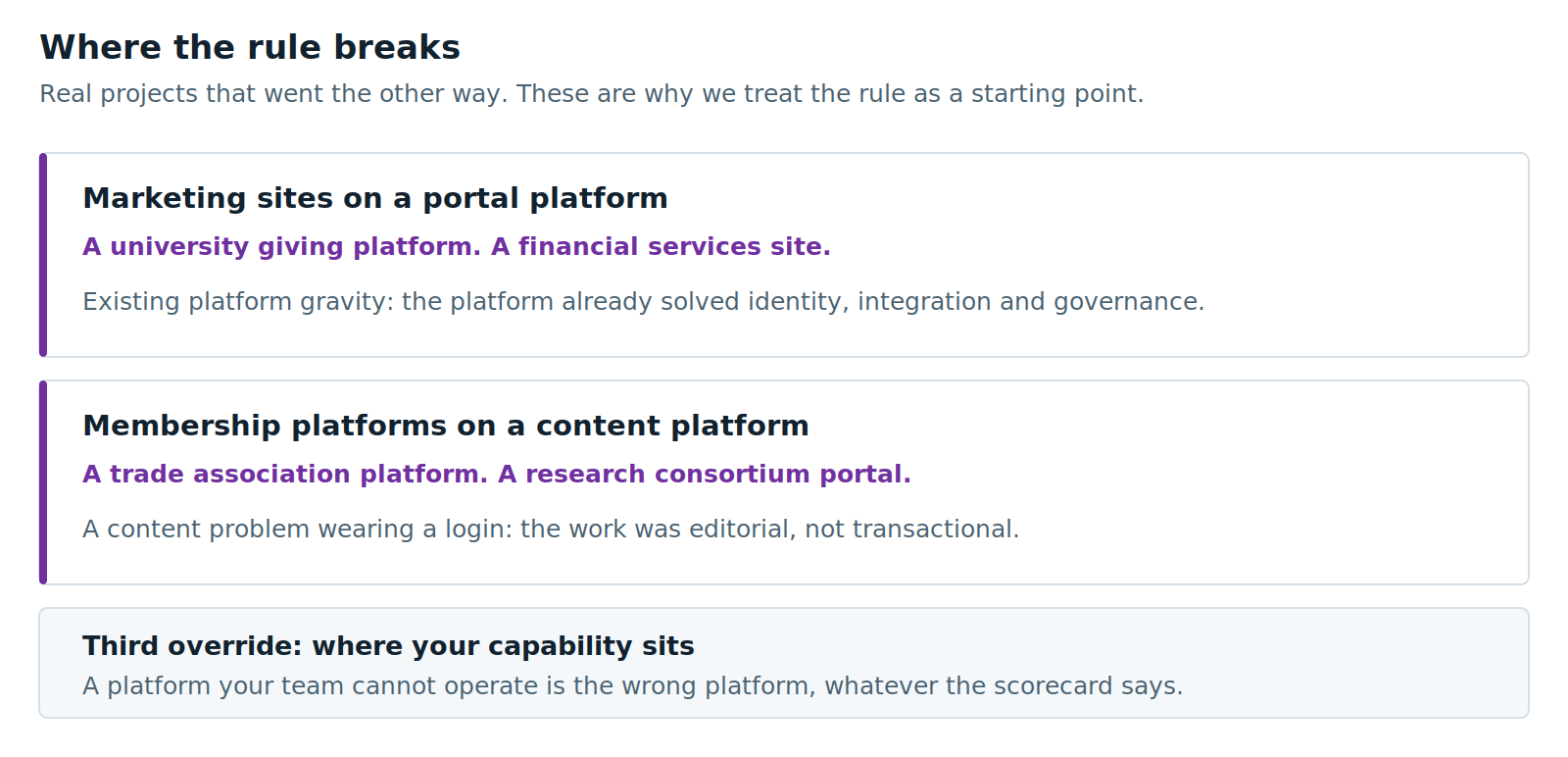
We have built public marketing websites on Liferay. A university giving platform and a financial services site are both live on Liferay today. Both would read as marketing workloads on the five questions.
We have built membership platforms on Contentful — a trade association platform and a research consortium portal — both with logins.
We do not regard those as mistakes. They are the three overrides.
Override One: Existing Platform Gravity
If an organization already runs a mature Liferay environment with identity, integration and governance solved, adding a marketing site to it is often cheaper and faster than standing up a second platform. Even where a standalone content platform would win a greenfield comparison.
The right unit of analysis is the whole platform, not the single site. This is also why we will sometimes recommend extending a platform we did not choose and would not have chosen.
Override Two: A Content Problem Wearing a Login
Some membership and association platforms look like portals because of the authentication. The actual work is editorial — standards, technical documentation, research, training material, published at volume to members and the public.
The login is access control on a content problem, not an integration problem. Structured content wins there.
Override Three: Where Your Capability Sits
A platform your team cannot operate is the wrong platform, whatever the architectural fit says.
A small marketing team with no engineering support is a real constraint and should move the answer. We would rather deliver something you can run than something that scores well.
The Third Path We Have to Mention
There is an option that involves neither product, and we would rather raise it than have you wonder why we did not.
For the authenticated half, you can skip the platform entirely and build a custom Next.js application. Identity from Entra ID, Okta or Auth0. Content from a headless CMS. Data from direct API integration.
For a transactional portal — show this user their data, let them submit a request — this is often the cleanest architecture, and we build them.
The line is collaboration. If the portal needs message boards, forums, document sharing, comments or notifications, a CMS provides none of it. You license a separate community product and integrate it, or you build one, and building one is a much larger project than it first appears.
Liferay includes all of that natively. That is the honest reason we route collaborative portals to a platform and transactional ones sometimes to a custom build. We cover the trade-off in full in the three ways to split a public website and a portal.
When the Answer Is Both
At the enterprise end this is common, and vendors who sell one thing tend to handle it badly.
An organization leaving a legacy suite often has a public website and an authenticated portal, currently in one platform because that is what the suite promised.
Separating them is not a failure to consolidate. It is recognizing they were never the same workload — and that forcing them together is what made the incumbent expensive.
There are three ways to fill the two halves: best of breed (Contentful plus Liferay DXP), single vendor (Liferay for both, using its headless capabilities for the public website), or a content platform plus a custom portal. Each fits a different shape of organization, and we have written all three up in When You Need Both a Public Website and a Portal.
Whichever route, four layers stay shared: design system, content services, identity and the integration layer.
We will say plainly that this outcome suits us commercially. It is also, in these cases, correct. Both are true, and you should weigh the recommendation knowing it.
When We Recommend Neither
More often than you might expect from a firm that sells implementations.
Stay where you are when your content operation works, your integration surface is stable, your support status is current, and the pressure to move comes from a vendor roadmap rather than your own constraints. Replatforming is expensive and disruptive. It needs a constraint you can name. “The platform is old” is not one.
Stay on WordPress if you run one site with a small content team and no real integration requirements. WordPress is good at what it is for, and the threshold for leaving is higher than most vendors suggest. If you are below it, we will tell you.
Fix the operating model first when the real problem is governance rather than technology. A surprising share of “we need a new CMS” conversations are actually “we have no content governance and three teams with conflicting priorities.”
New software does not fix that. It gives the same dysfunction a more expensive home. We would rather say so in week one than find out together in month eight.
How to Hold Us to This
Fair scepticism deserves practical answers.
Ask for the recommendation before we scope the work. If a platform recommendation arrives attached to a large statement of work, the incentive is doing some of the arguing. We will do a platform assessment as a standalone engagement, and we will tell you when the answer is a platform we do not implement.
Ask which questions would change our answer. Anyone who cannot name the conditions under which they would recommend differently is not running a diagnostic.
Ask for a reference where we recommended against ourselves. We have them.
Ask both practice leads directly. Kaushik Mukherjee leads our Contentful practice. Matt Wolinski and Derek Nerenberg lead our Liferay practice. They review each other’s positioning articles for fairness to the other platform.
If you want to pressure-test a recommendation, ask to speak to the lead whose practice would lose the work.
Further Reading
- Liferay’s comparison against Sitecore — useful mainly for where Liferay draws its own boundary
- Contentful’s guide to content migration planning — the sequencing advice holds regardless of destination
- Adobe’s AEM release roadmap — if a support deadline is what brought you here
- Our own guide to content modeling in Contentful — the part of a content platform migration most teams underestimate
Vivek Agarwal is CTO and VP of Digital Experience Solutions at XTIVIA. XTIVIA has implemented enterprise content and portal platforms for over twenty years and holds partnerships with both Liferay and Contentful. We have a commercial interest in you choosing one of them. This article exists because we would rather that interest be visible than implied. Talk to us.