
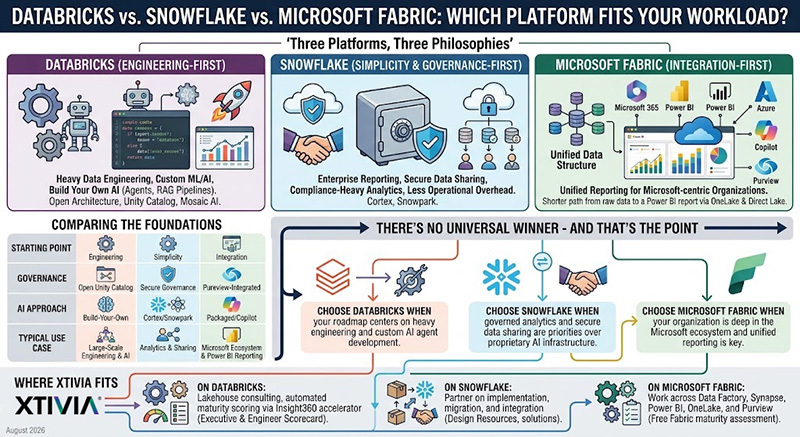
Summary: Choosing the right data platform depends on your workload: Databricks excels in custom AI and engineering; Snowflake prioritizes governed SQL analytics and operational simplicity; and Microsoft Fabric offers deep integration for Microsoft-centric enterprises. Rather than chasing a single “best” tool, many organizations are adopting hybrid architectures. XTIVIA provides expert consulting and maturity assessments to help you align your platform choice with your specific data engineering and AI goals.
Table of contents
For years, choosing a data platform meant picking a warehouse for reporting and a separate lake for everything else. That line is disappearing. Databricks, Snowflake, and Microsoft Fabric are all converging on the same goal — a single governed foundation that can run analytics, engineering, and AI workloads without shuffling data between systems — but each is getting there from a different starting point. That difference matters more than any feature checklist when you’re deciding where to invest.
Three Platforms, Three Philosophies
Databricks built its reputation on engineering. Growing out of Apache Spark, it’s designed for teams doing heavy data engineering, custom model training, and large-scale AI development. Its governance layer (Unity Catalog) and AI tooling (Mosaic AI) are aimed at organizations building their own AI capabilities rather than just consuming a vendor’s packaged AI features. If your roadmap includes custom models, RAG pipelines, or AI agents built on your own data, this is the environment most built for that work.
Snowflake built its reputation on simplicity and governance. It abstracts away a lot of the infrastructure tuning that engineering-first platforms expose, and its long-standing strength in secure, governed data sharing across business units and partner organizations remains a real differentiator. Snowflake has extended into AI through Cortex and Snowpark, but the core value proposition is still: strong SQL analytics, strict governance, and less operational overhead. It tends to be the better fit for teams whose primary workloads are enterprise reporting, compliance-heavy analytics, or cross-company data collaboration rather than ground-up AI engineering.
Microsoft Fabric built its reputation on integration. Rather than being the fastest engine at any one task, Fabric’s advantage is that it’s already wired into Azure, Microsoft 365, Power BI, Copilot, and Purview. For organizations already standardized on the Microsoft stack, that means less identity and licensing complexity, and a shorter path from raw data to a Power BI report via Fabric’s OneLake storage layer and Direct Lake query mode. Fabric is a particularly natural fit for Microsoft-centric enterprises and mid-market organizations that want unified reporting without assembling a best-of-breed stack themselves.
There’s No Universal Winner — And That’s the Point
None of these three platforms is objectively “best.” They optimize for different things:
- Choose (or lean into) Databricks when your workloads center on data engineering, custom ML, or AI agent development, and you want an open, engineering-first architecture.
- Choose (or lean into) Snowflake when governed analytics, secure data sharing, and operational simplicity matter more than building proprietary AI infrastructure.
- Choose (or lean into) Microsoft Fabric when your organization is already deep in the Microsoft ecosystem and unified reporting is the priority.
What we’re seeing more often in practice isn’t a single-platform decision at all. Many enterprises are running hybrid architectures — Databricks for engineering and AI development, Snowflake for governed analytics, Fabric and Power BI for enterprise reporting — rather than standardizing on one vendor exclusively. Interoperability, not exclusivity, is increasingly the more realistic strategy.
Where XTIVIA Fits
This isn’t a purely theoretical decision for us — we offer dedicated consulting services and assessments on both platforms:
- On Databricks, our consulting practice helps organizations design, implement, and manage Lakehouse architectures, and our Insight360 accelerator gives Databricks environments automated maturity scoring across security, governance, performance, and cost — turning “is our Databricks environment healthy?” into a concrete, actionable scorecard for both executives and engineers.
- On Snowflake, we partner on implementation, migration, and integration — helping teams designate resources, identify connectivity points, and define solution parameters so a migration happens without disrupting the business.
- On Microsoft Fabric, our team works across the full component set — Data Factory, Synapse Data Engineering and Data Warehouse, Power BI, OneLake, and Purview — and offers a free Fabric maturity assessment covering architecture, governance, security, and DevOps.
- Because we’ve supported customers across traditional data warehouses, data lakes, and now lakehouses — using tools spanning Microsoft, Databricks, IBM, Teradata, and others — we’re positioned to have the platform-fit conversation without a predetermined answer in mind.
The Real Question to Ask
The right starting question isn’t “which platform is best” — it’s “what does our workload actually look like, and where is it heading?” A team building custom AI agents on proprietary data has a very different answer than a team trying to unify reporting across a Microsoft-standardized organization. Answering that honestly, before committing budget and migration effort, is where most successful platform decisions actually begin.
Not sure where your organization’s workload profile points? We run maturity assessments for both Databricks and Microsoft Fabric environments — reach out to talk through where your team currently stands.
Sources:
- The CODEW: Enterprise Data Platforms in 2026 — Databricks, Snowflake, Microsoft Fabric & AI Analytics
- XTIVIA: Microsoft Fabric Consulting and Development
- XTIVIA: Microsoft Fabric Maturity Assessment
- XTIVIA: Databricks Consulting
- XTIVIA: Seamless Scaling — How Insight360 Helps You Get the Most Out of Databricks
- XTIVIA: Snowflake Services