
Last reviewed: October 12, 2026
SUMMARY:
- Contentful is right for enterprise teams whose content must reach many sites, apps and languages, and who are ready to assemble the rest of the stack.
- Its strengths are mature APIs, flexible content modeling, many locales in one space, SaaS delivery and AI tools that draft, translate and check content in bulk.
- Plan real work for analytics, personalization, rich-text migration and governance, because none of them arrive finished.
- Salesforce now owns Contentful, which helps Salesforce-stack customers and gives everyone else questions to settle at contract time.
- Skip Contentful if most of your experience sits behind a login, you run one small site, or you want an all-in-one suite.
Table of Contents
- Is Contentful Right for Enterprise? The Short Answer
- Seven Criteria That Matter in a Replatform
- Where Contentful Is Strong
- Where Contentful Falls Short, and the Work to Close the Gap
- What It Would Take to Leave Contentful
- Is Contentful Ready for Enterprise AI?
- Is Contentful Right for Enterprise After the Salesforce Deal?
- Who Should Not Choose Contentful
- Is Contentful Right for Enterprise Teams Like Yours? A Two-Week Test
Is Contentful Right for Enterprise? The Short Answer
Is Contentful right for enterprise use? Yes, when your content has to travel. If the same product copy, offers and articles feed several sites, apps and markets, Contentful fits well. It’s a poor fit when most of your experience sits behind a login, or when you want one suite that does everything.
Contentful is a headless CMS. A headless CMS stores structured content and sends it to any front end through an API. Contentful runs as software as a service (SaaS), so you don’t host it, patch it or upgrade it.
Most write-ups from Contentful partners are endorsements. Enterprise architects tend to discount those. So this evaluation covers both halves: where Contentful is strong, and where it falls short.
A disclosure first. XTIVIA is a Contentful partner and a Liferay Gold Partner. We don’t implement AEM or sell Sitecore. Where another platform is the better answer, we’ll say so.
 Contentful is right for enterprise teams whose content must reach many sites, apps and languages. It’s the wrong choice when most of the work happens behind a login.
Seven Criteria That Matter in a Replatform
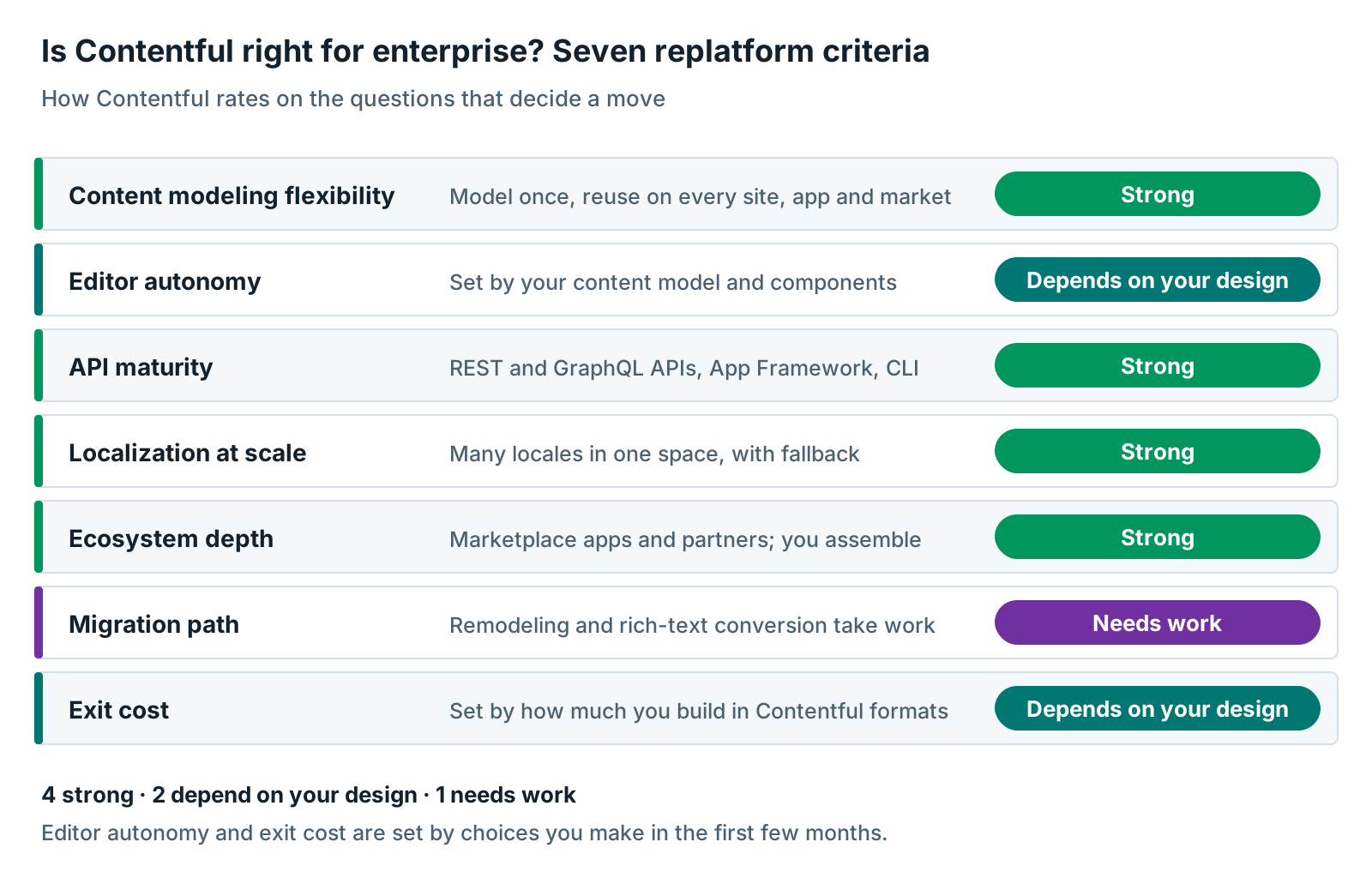
Seven criteria decide whether a move to Contentful will pay off. They are content modeling flexibility, editor autonomy, API maturity, localization at scale, ecosystem depth, migration path and exit cost. These criteria matter more than a feature matrix. Every serious CMS ticks most feature boxes. The seven criteria show what living with the platform is like.
Here’s how we rate Contentful on each one.
| Criterion | The question to ask | Contentful |
|---|---|---|
| Content modeling flexibility | Can you model content once and reuse it everywhere? | Strong |
| Editor autonomy | Can editors build and change pages without a developer? | Depends on your design |
| API maturity | Are the APIs complete, documented and stable? | Strong |
| Localization at scale | Can one space serve every market and language? | Strong |
| Ecosystem depth | Can you find tools and partners for the rest of the stack? | Strong |
| Migration path | How hard is it to get your existing content in? | Needs work |
| Exit cost | What would it take to leave in five years? | Depends on your design |
Two rows say “depends on your design.” That isn’t a dodge. Editor autonomy and exit cost are set by choices your team makes in the first few months, not by the product.
Editor autonomy depends on the content model and the components. Get them right, and marketers publish on their own. Get them wrong, and every change needs a developer. Exit cost depends on how much you build in Contentful-specific formats. Section 5 covers that.
Where Contentful Is Strong
Contentful is strongest where enterprise content gets complicated: many channels, many markets and many teams. Four strengths stand out in the platform work we do. Each one is a reason enterprise teams pick it over a traditional suite.
API-first, with a mature App Framework. Almost everything in Contentful is reachable through an API. That includes content, the content model, assets and settings. Content goes out through REST and GraphQL APIs on a global content delivery network (CDN). The App Framework lets you extend the editor screens, add custom fields and connect other tools. Contentful’s Marketplace adds ready-made apps. We’ve written a step-by-step tutorial for building a custom Contentful app.
Many locales from one space. A space is Contentful’s container for a project’s content. One space can hold many languages. Each field can be localized or shared, and one locale can fall back to another. Contentful’s technical limits allow up to 500 locales per environment, and your plan sets the real number. For a company that runs a separate site copy per market, this is often the largest saving.
Studio for visual pages, built on structured content. Contentful Studio lets marketers assemble pages visually from components. The components still pull from structured entries. So editors get a page builder without turning content back into page-shaped blobs. Studio is an add-on to the Enterprise plan, priced separately.
SaaS with nothing to patch. Contentful runs the platform. Your team has no servers, no security patches and no version upgrades. The Enterprise plan offers an uptime service level of up to 99.99%. Compare that with on-premise AEM or Sitecore XP, where each upgrade is a project.
Underneath all four is the content model. Content types aren’t tied to pages, so one entry can feed a website, an app and a partner feed. Our guide to content modeling in Contentful explains the approach we use.
Where Contentful Falls Short, and the Work to Close the Gap
Contentful falls short in four places that a full digital experience platform (DXP) covers out of the box: analytics, deep personalization, rich-text migration and governance. None of these rules Contentful out. Each one is work to plan and budget for from the start.
Analytics are thinner than a full DXP. Contentful launched its own Analytics product as a beta in October 2025. It’s newer and lighter than the analytics inside a suite like Sitecore or Adobe. Most teams we work with add GA4 or a similar tool. Decide early what you’ll measure, where the data lands and who owns the reports.
Deep personalization costs extra. Contentful Personalization grew out of Contentful’s purchase of Ninetailed. It’s sold only as an add-on to the Enterprise plan, which sales quotes. The Free and Lite plans have published prices, and Lite is $300 a month, according to Contentful’s pricing page. For real-time targeting across channels, you may also need a customer data platform (CDP). A CDP joins what you know about each customer into one profile.
Rich-text migration is rarely clean. Legacy WYSIWYG editors store rich text as HTML. Contentful stores it as a structured JSON document. Plain paragraphs convert well. Inline styles, embedded widgets, pasted Word HTML and layout tables don’t. Each needs a rule, an embedded entry or a person. In our experience, this is the hardest content step in most moves.
Governance has to be designed. Contentful gives you roles, environments and approval tools. It doesn’t give you a governance model. Someone must own the content model, approve changes to it and decide who publishes what. Teams that skip this end up with near-duplicate content types and confused editors.
There’s one more practical limit. The management API has rate limits, and content types have field limits. Bulk import scripts need to pause and retry. Check the technical limits before you design a large migration.
Most of these gaps share one cause. Contentful is a content platform, not a suite. You assemble the rest: front end, search, analytics, personalization, assets and identity.
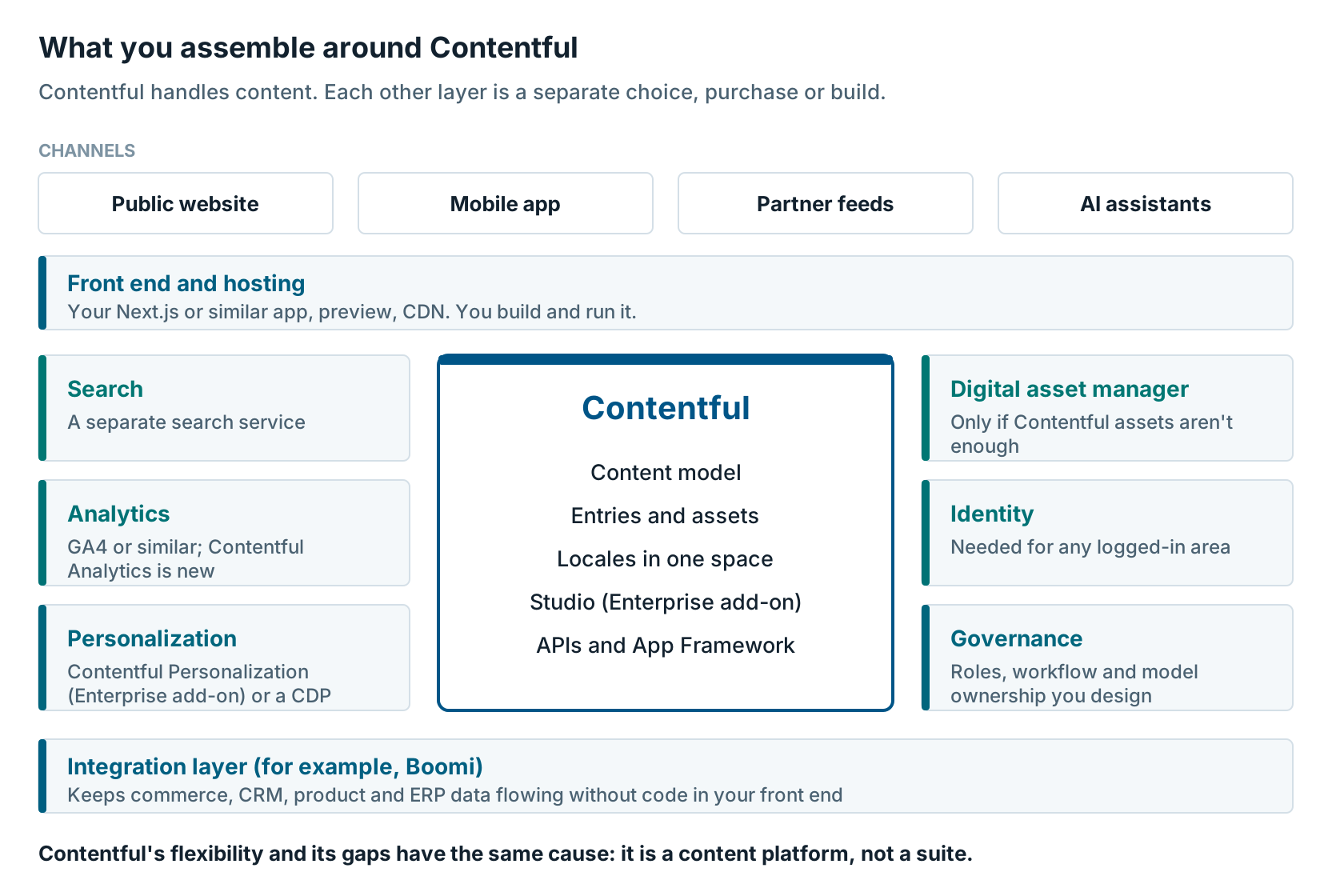
Enterprise moves are usually integration projects too. Commerce, CRM, product and ERP data must flow to and from the content. An integration platform keeps that logic out of your front end. Our Boomi integration team does this work alongside our Contentful practice.
What It Would Take to Leave Contentful
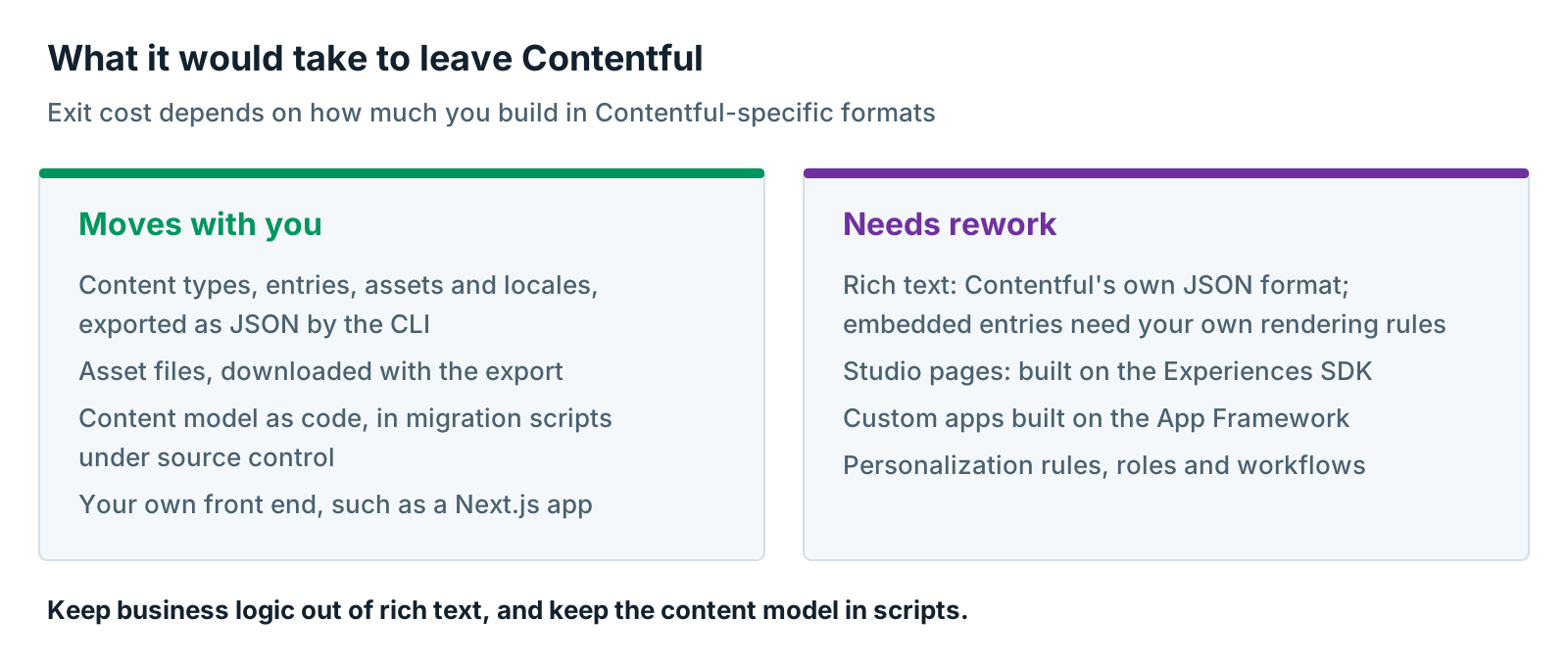
Leaving Contentful is easier than leaving most legacy DXPs, because your content and your content model export as JSON. What doesn’t move cleanly is anything stored in a Contentful-specific format: rich text, Studio pages and custom apps. How much of that you build decides your exit cost.
What moves with you:
- Content and assets. The Contentful CLI can export a whole space to a JSON file. That includes content types, entries, assets and locales. Asset files can be downloaded too.
- The content model as code. With Contentful’s migration tooling, every content type change is a script in source control. That history documents your model better than any diagram.
- Your front end. If your front end is your own Next.js app, it stays yours. Only the data layer changes.
What needs rework:
- Rich text. The JSON format is Contentful’s own. Open-source renderers turn it into HTML. But embedded entries and assets need your own rendering rules.
- Studio pages. Layouts built in Studio depend on Contentful’s Experiences SDK. Another CMS can’t read them as pages.
- Custom apps. Apps built on the App Framework run inside Contentful’s editor. They’d need rebuilding.
- Settings. Personalization rules, roles and workflows are Contentful settings. Plan to set them up again.
Is Contentful Ready for Enterprise AI?
Yes, for content work. Contentful’s AI tools draft, translate and check content in bulk, and they let AI agents work inside your content under the same roles and approvals as your editors. Salesforce has promised a link to Agentforce, its AI agent platform, but hasn’t shipped it. Most of the AI features are sold by plan or usage, so confirm what your contract includes.
AI Actions in the editor. AI Actions draft, translate, rewrite and check content inside Contentful. They can run across hundreds of entries at once, and you review the changes before anything publishes. You can ground them in your own content and brand materials, choose the AI model, and set up checks for legal, compliance or brand rules. AI Actions are only on some plans, with a yearly usage allowance and charges above it, according to Contentful’s AI Actions guide.
Automations. Automations chain triggers, conditions and actions into a flow. A common pattern is to generate metadata and alt text, then run a brand or compliance check before publishing.
An MCP server for AI agents. The Model Context Protocol (MCP) is an open standard that lets AI assistants and agents use outside tools. Contentful hosts a remote MCP server that an agent signs in to as a Contentful user. Through it, the agent can read and change entries, assets, content types and releases. There’s also an open-source version you can run yourself. Treat an agent like any new editor: give it a role with only the access it needs, and keep approvals in place.
Palmata for AI search. Palmata, launched in June 2026, shows how answer engines like ChatGPT and Gemini describe your brand, and which content they draw on. It suggests what to change first. It’s a separate product from the CMS.
Structured content is easier for AI tools to read and write than content trapped in page layouts. That makes the content model even more important. For more on the Agentforce link, see the next section.
Is Contentful Right for Enterprise After the Salesforce Deal?
Is Contentful right for enterprise teams now that Salesforce owns it? For Salesforce-stack customers, the deal is likely a plus. For everyone else, it’s a reason to ask more questions at contract time, not a reason to walk away. European public-sector buyers have one more question: data sovereignty.
The facts so far. Salesforce announced its agreement to buy Contentful on June 1, 2026. The deal closed on September 1, 2026. Salesforce’s announcement stresses that Contentful will stay composable. Contentful’s founder wrote that its API-first architecture “will enhance Salesforce’s Headless 360”. Neither post sets out a roadmap for customers who use other vendors’ tools. Salesforce also says Contentful content will become available to Agentforce, its AI agent platform. It hasn’t published a timeline.
What it means for you:
- If Salesforce runs your CRM, service or marketing, expect tighter links between Contentful and Salesforce products over time. Judge them on what ships, not on what’s promised.
- If you use other tools, ask how Contentful will stay open to them. Put what you can in the contract: renewal price caps, data export rights and notice periods for API changes.
Then there’s the European question. Contentful offers EU data residency, which stores your content and user profiles in the EU. It’s an add-on for the top-tier plan. It answers where the data is stored, with some limits. Contentful’s own page says it can’t guarantee EU data is only processed in the EU. For example, a Marketplace app may call a US-hosted service. Content is also cached on global CDNs. Ask, too, where AI Actions send your content for processing. And residency doesn’t fully answer which laws can reach the data.
Contentful is now owned by Salesforce, a US company. The US CLOUD Act lets US authorities require US-based providers to hand over data in their control, even when it’s stored abroad. The US Department of Justice’s CLOUD Act resources explain how the law works. European public-sector buyers tend to ask how a vendor handles such requests.
We’re not lawyers, and this isn’t legal advice. If data sovereignty matters to you, bring your legal and data protection teams in early. Ask Contentful which plans include EU residency, which services it covers, and how it responds to government data requests.
Who Should Not Choose Contentful
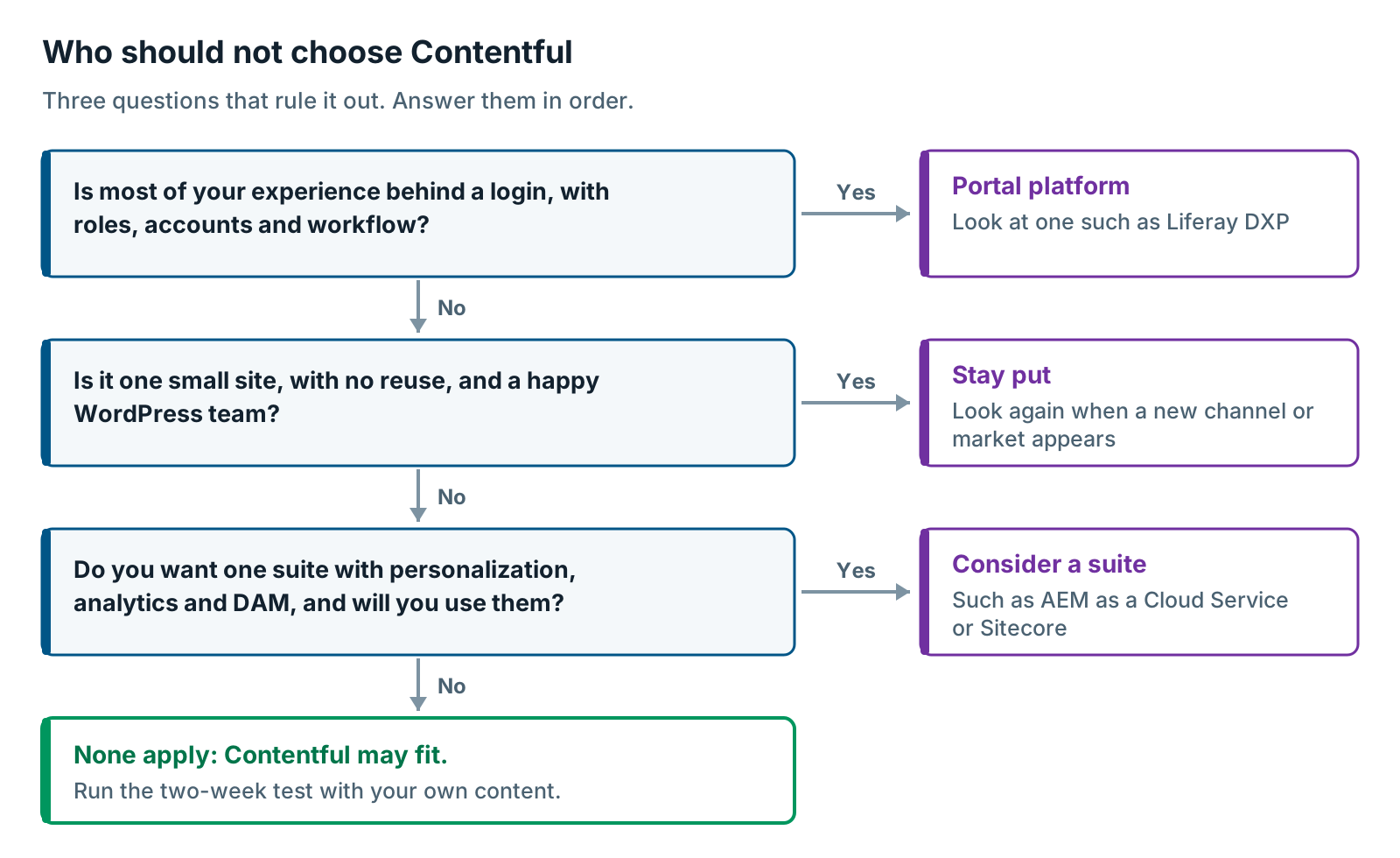
Three kinds of organizations should not choose Contentful. Those whose experience lives mostly behind a login. Those running one small site with no reuse. And those who want an all-in-one suite and will use all of it. In each case, another option is likely to fit better.
1. Most of your experience is behind a login. If customers, dealers or members log in to see their own data and get work done, you need a portal platform. Contentful has no visitor accounts, visitor roles, company accounts or business workflow. You’d build all of that in custom code. On AEM today? Read AEM vs Liferay for Portals: What to Do With the Login Side of AEM. Heading to Liferay? Read Moving to Liferay? Build on the New Liferay CMS, Not Web Content. Our decision rule for Contentful vs Liferay explains how we choose.
One nuance: a members-only library is a content problem, not a portal problem. We’ve seen membership organizations run that kind of logged-in content well on Contentful.
2. One small site, no reuse, and a happy WordPress team. Contentful’s value comes from reuse across channels, markets and teams. A single site in one language doesn’t use that. If your WordPress editors are productive and the site performs, a move adds cost and a new model to learn. Stay put, and look again when a second channel or market appears.
3. You want an all-in-one suite, and you’ll use it. Some teams want personalization, analytics, testing and a digital asset manager (DAM) in one contract. If you’ll use those features, a suite like AEM as a Cloud Service or Sitecore can make sense. On AEM, read AEM as a Cloud Service vs Contentful: What the TCO Comparison Leaves Out. On Sitecore, read Sitecore XM Cloud vs Contentful: An Honest Comparison for XP Customers. The test is use, not ownership. Check which suite features your teams touch today.
Not sure which workload you have? Start with Legacy DXP Migration: Are You Replacing a CMS or a Platform? Running both a public website and a portal? Read When You Need Both a Public Website and a Portal.
Is Contentful Right for Enterprise Teams Like Yours? A Two-Week Test
The best way to answer “is Contentful right for enterprise teams like ours?” is a short, hands-on test with your own content and editors. Two weeks is enough to test all seven criteria. Here’s a plan you can run yourself in a Contentful trial or sandbox space.
- Write down the questions (days 1–2). List the sites, apps, markets and languages you’ll need in three years. Note which parts sit behind a login. Agree how you’ll score the seven criteria.
- Model a representative set of content types (days 2–4). Pick five to eight types that cover your hardest cases. Include a reusable component, a localized item, a page assembly and something with messy rich text. Write each one as a migration script.
- Load real content (days 4–5). Move a few dozen real items, including your worst rich text. Note what converts, what needs an embedded entry and what needs a person.
- Run the editor test (days 6–7). Give three or four real editors a list of everyday tasks. Watch them work without developer help. Time each task.
- Run the API test (days 7–8). Build one real page in your own front end, with preview. Run a bulk script against the management API to see how rate limits affect you. Connect one other system, such as search or your CRM.
- Run the exit test (day 9). Export the space with the Contentful CLI. Convert the rich text to HTML. List what didn’t come across.
- Score and decide (day 10). Rate each criterion as strong, depends on your design, or needs work. Compare the result with what your current platform gives you today.
If the test goes well, the next questions are how to migrate and how to build the content model. Read Contentful Migration Without Freezing Your Roadmap and Reverse-Engineering a Content Model from a Legacy CMS.
If you’d like help running the test, talk to our Contentful team. If the answer is that Contentful isn’t right for your enterprise, we’ll tell you.
Further reading
- Contentful technical limits — locale, content model and API limits, from Contentful
- Import and export content with the Contentful CLI — what a space export contains
- Contentful EU data residency — how EU hosting works and who can use it
- Salesforce signs agreement to acquire Contentful — the announcement and closing note
Kaushik Mukherjee leads XTIVIA’s Contentful practice and co-wrote XTIVIA’s guide to content modeling in Contentful. He helps teams plan and deliver moves from legacy CMS platforms to Contentful. Talk to us.