
Last reviewed: October 9, 2026
SUMMARY:
- For a Sitecore XP team, Sitecore XM Cloud vs Contentful is a choice between two rebuilds, because moving from XP to XM Cloud is not an upgrade.
- XM Cloud keeps your content tree, your Sitecore skills and a stronger built-in personalization path.
- Contentful wins on content reuse across channels and locales, composable integrations and pricing you can see.
- XM Cloud is the better choice when personalization, Sitecore CDP or a large in-house Sitecore team drives your value.
- Five questions about personalization, team, channels, logins and Salesforce point to your answer.
Table of Contents
- Why Sitecore XM Cloud vs Contentful Starts With a Rebuild
- What Each Path Keeps From Your Sitecore XP Build
- Sitecore XM Cloud vs Contentful Across Nine Dimensions
- When XM Cloud Is the Right Answer
- Where Contentful Pulls Ahead
- The Salesforce Factor in Sitecore XM Cloud vs Contentful
- When to Stay on Sitecore XP for Now
- Five Questions to Decide Sitecore XM Cloud vs Contentful
Why Sitecore XM Cloud vs Contentful Starts With a Rebuild
For a Sitecore XP team, Sitecore XM Cloud vs Contentful is a choice between two rebuilds. XM Cloud is a different product, not the next version of XP. Your front end, your custom code and your personalization all need rework on either path. So the fair question is which new platform fits the next seven years.
First, a note on names. In November 2025, Sitecore relaunched XM Cloud as part of a new platform called SitecoreAI. Most teams still say XM Cloud, and so will we.
Here’s why XM Cloud is a rebuild. Sitecore’s own list of limitations for SitecoreAI says these XP features aren’t available:
- MVC renderings, the server-side page templates most XP sites use
- The Experience Database (xDB) and xConnect, along with existing personalization rules
- Experience Analytics, Marketing Automation and the email tool (EXM)
- Sitecore Forms. SitecoreAI has its own Forms tool, but it sends submissions on to other systems instead of storing them.
- Custom search indexes
- Content delivery servers
Instead, XM Cloud is headless. A headless CMS stores content and sends it to a separate front end through an API. In XM Cloud, content is published to a hosted service called Experience Edge. The front end is usually a Next.js app built with Sitecore’s Content SDK.
Custom code moves too. For custom pipelines, jobs and services, Sitecore’s own guidance says alternatives “must be explored using Edge Functions, Headless architecture, or external services” instead.
Sitecore isn’t hiding any of this. It’s simply the nature of the move. In the XP assessments we run, the front-end and integration work tends to be similar in size whichever platform the team picks.
 Moving from Sitecore XP to XM Cloud is a rebuild, not an upgrade. Once both paths need a rebuild, compare XM Cloud and Contentful as two new platforms.
The clock matters, too. On June 1, 2026, Sitecore made security fixes and incident support in Extended Support a paid add-on. XP 10.0 and 10.1 leave Extended Support on December 31, 2026, per Sitecore’s support lifecycle. Our article on what Sitecore XP Extended Support costs you now covers the numbers.
What Each Path Keeps From Your Sitecore XP Build
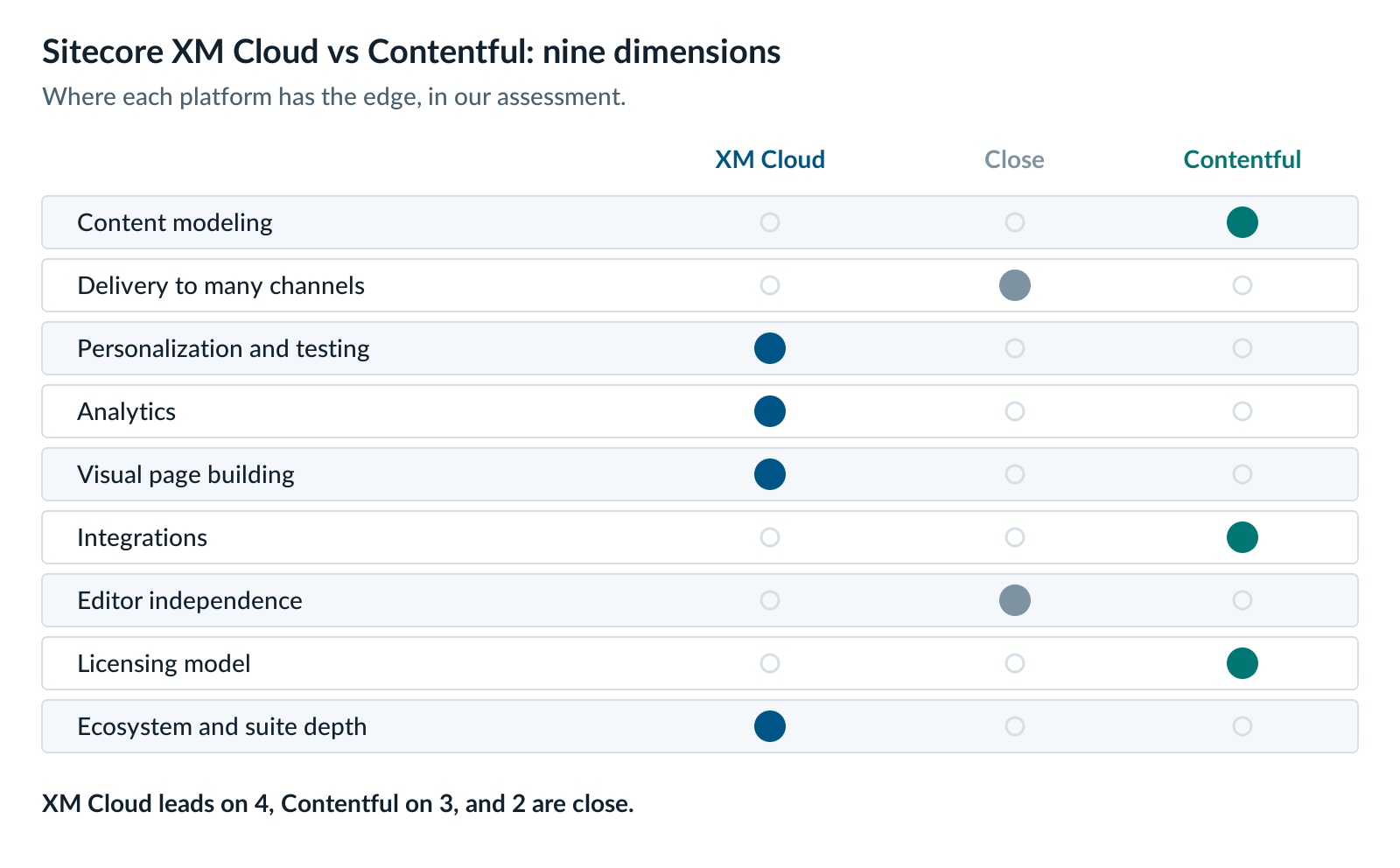
XM Cloud keeps more of what you already have. Your content tree, templates, editor habits and Sitecore developers all carry over in some form. Contentful keeps your content, but asks you to remodel it. That’s a real cost, and it’s also the main reason teams choose Contentful.
Here’s how the pieces of a typical XP build fare on each path.
| Part of your XP build | Moving to XM Cloud | Moving to Contentful |
|---|---|---|
| Content items | Carry over in the same tree | Migrate into new content types |
| Templates | Carry over, with rework for headless | Remodel as content types |
| MVC renderings | Rebuild as Next.js components | Rebuild as front-end components |
| Custom pipelines and code | Move to edge functions or external services | Move to the front end or external services |
| xDB data and personalization rules | Not carried over. Rebuild in Sitecore Personalize. | Not carried over. Rebuild in your chosen tools. |
| Editor experience | Familiar Sitecore concepts | New tool, new habits |
| Developer skills | Sitecore and .NET skills still count | JavaScript skills matter most |
Look at the middle rows. The front end and custom code need rebuilding either way. The difference is in the first row and the last two.
XM Cloud’s head start is real. Editors know the tree. Developers know the templates. That can save months of training and change management.
Contentful’s remodel is real, too. But many XP builds carry years of page-shaped templates that mix content with layout. Remodeling them is how you get content you can reuse across sites, apps and channels. Our guide to content modeling in Contentful explains the approach.
Sitecore XM Cloud vs Contentful Across Nine Dimensions
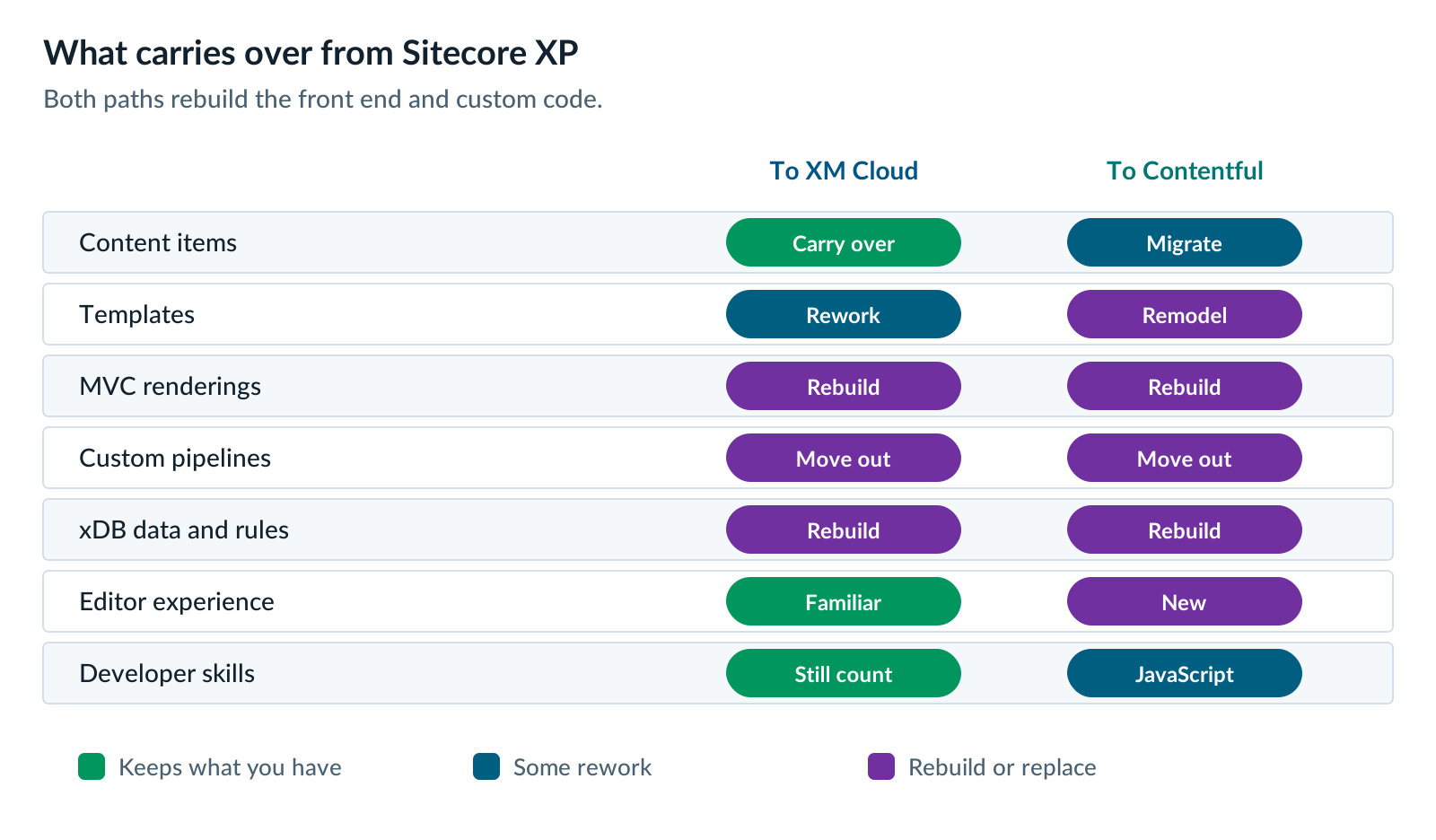
On a straight comparison, Sitecore XM Cloud wins on personalization, analytics, visual page building and suite depth. Contentful wins on content reuse, integration into a composable stack and pricing transparency. The rest are close. Here are the nine dimensions we use when we run this comparison with clients.
A quick disclosure first: XTIVIA is a Contentful partner and a Liferay Gold Partner. We don’t sell Sitecore. We’ve tried to argue XM Cloud’s case as fairly as a Sitecore partner would.
| Dimension | Sitecore XM Cloud | Contentful | Edge |
|---|---|---|---|
| Content modeling | Templates with inheritance in a page tree. Familiar to Sitecore teams. | Content types and references. Built for reuse, with no page tree by default. | Contentful for reuse |
| Delivery to many channels | GraphQL through Experience Edge | REST and GraphQL APIs on a global CDN | Close |
| Personalization and testing | Rules, A/B/n tests and page analytics built in. Full Sitecore Personalize and CDP as add-ons. | Contentful Personalization, on Enterprise plans only | XM Cloud |
| Analytics | Page analytics built in, plus Sitecore CDP | Lighter built-in analytics. Most teams add GA4 or similar. | XM Cloud |
| Visual page building | Sitecore Pages, a mature drag-and-drop page builder, included | Contentful Studio, newer and priced separately | XM Cloud |
| Integrations | Sitecore Connect, a low-code integration tool, paid beyond a trial tier | App Framework, webhooks and a large marketplace | Contentful for composable stacks |
| Editor independence | Strong for page editing once components exist | Strong once the content model is right | Close |
| Licensing model | No published prices. Sales-led. | Free and Lite tiers published. Enterprise is sales-led. | Contentful for transparency |
| Ecosystem and suite depth | A full DXP suite. A Leader in Forrester’s DXP Wave (Q4 2025). | A large headless ecosystem. You assemble the suite. | XM Cloud |
Three rows deserve a closer look.
Personalization. SitecoreAI includes entry-level access to Sitecore CDP, Personalize, Search and Content Hub, according to Sitecore’s SitecoreAI FAQ. That’s a lot in one contract. Contentful’s personalization is newer, and it’s sold only on Enterprise plans.
Visual page building. Sitecore Pages lets editors drag and drop components onto a page, and it comes with XM Cloud. Even Contentful’s own Sitecore migration guide rates it strong. Contentful Studio does the same job well, but it’s newer and priced separately.
Licensing. Contentful publishes its entry prices. Its Lite plan is $300 a month, and Enterprise is quoted by sales. Sitecore doesn’t publish prices for XM Cloud. At enterprise scale, both are negotiated. But you can start a Contentful proof without a sales cycle.
One more thing to know. Contentful runs a Sitecore buyout offer. Eligible customers can get up to a year of Contentful at no charge, based on what’s left on their Sitecore contract. Conditions apply. It can ease the overlap year, when you pay for both platforms. It doesn’t pay for the rebuild, so get the terms in writing and model it as a one-time credit.
When XM Cloud Is the Right Answer
XM Cloud is the right answer when Sitecore’s suite is where your value comes from. That’s usually one of three cases. In each, Contentful would make you rebuild something you already do well, with less to show for it.
First, a quick test. Many XP customers bought the full suite but only use it as a CMS. If that’s you, these three cases probably don’t apply, and XM Cloud’s suite advantage shrinks.
1. Personalization drives revenue, and you’ll use Sitecore Personalize or CDP. If your team runs real tests and audience targeting today, that skill is worth keeping. XM Cloud gives it a clear home. On Contentful, you’d rebuild it with Contentful Personalization or a separate customer data platform (CDP). That’s doable, but it’s a second project.
2. You have a strong in-house Sitecore team. Sitecore developers and architects are hard to hire. If you already have them, XM Cloud keeps their knowledge useful. Your editors also keep the tree they know. Moving to Contentful means retraining both groups.
3. You depend on Sitecore Search or Content Hub. If your site search runs on Sitecore Search, or your assets live in Content Hub, XM Cloud keeps them close. Contentful would add separate search and asset tools to choose, buy and connect.
Where Contentful Pulls Ahead
Contentful pulls ahead when content has to travel. If the same product copy, article or offer needs to show up on several sites, in apps and in many languages, Contentful’s model fits better. It also suits teams that want to choose every other tool in the stack themselves.
Four strengths stand out:
- Content built for reuse. Content types aren’t tied to pages. One entry can feed a website, a mobile app, a kiosk and a partner feed.
- Many locales in one place. One space can hold many languages, with fallback from one locale to another. Contentful’s technical limits allow up to 500 locales per environment. Your plan sets the real number.
- A content layer that doesn’t dictate the rest. Use the front end, search, analytics and asset tools you prefer. Contentful just handles content.
- Marketers who publish without developers. Once the content model and components are right, editors can build and change pages on their own.
There’s a trade-off. “Choose every tool yourself” also means “buy and connect every tool yourself.” Analytics, search, assets and personalization become separate decisions. Rich text from XP also needs custom conversion, because Contentful stores rich text in a structured format, not HTML. In our experience, that conversion is the hardest content step in the move.
The Salesforce Factor in Sitecore XM Cloud vs Contentful
If Salesforce runs your customer data or marketing, the Salesforce factor may favor Contentful in Sitecore XM Cloud vs Contentful over time. Salesforce now owns Contentful. But little has shipped yet. For everyone else, it’s a question to ask, not a reason to choose.
The facts so far: Salesforce announced its deal to buy Contentful on June 1, 2026. The deal closed on September 1, 2026. Salesforce’s announcement stresses that Contentful will stay composable. Contentful’s leadership has said the same about its API-first design. Salesforce also says Contentful’s content will become available to Agentforce, its AI agent platform. It hasn’t published a timeline.
What it means for you:
- Heavy Salesforce users can expect tighter ties over time between Contentful and Salesforce products. That’s a plus, but judge it on what ships, not what’s promised.
- Everyone else should ask how Contentful’s roadmap will stay open to other tools. Ask for specifics in your contract talks.
Sitecore does connect to Salesforce. It publishes connectors for Salesforce CRM and Marketing Cloud. But the versions we could find list Sitecore XP, not XM Cloud. You may be able to link XM Cloud to Salesforce through Sitecore Connect, Sitecore’s low-code integration tool. Connect has a free trial tier, but production use needs a paid plan. If Salesforce matters to you, ask Sitecore what Connect would cost at your volumes.
When to Stay on Sitecore XP for Now
Stay on Sitecore XP for now if you’re on a supported version and the site works. It also makes sense if a rebuild would land in the middle of a bigger change. XP isn’t dead. Sitecore released XP 10.5 in 2026. Its SitecoreAI FAQ says XP customers will keep getting full support and active product roadmaps.
Staying makes sense when:
- You’re on XP 10.4 or 10.5. XP 10.4 stays in Mainstream Support until December 31, 2027, and 10.5 is the newest release. You have time to plan.
- You get real value from xDB personalization. If it’s working, don’t throw it away in a hurry.
- A big business event is coming. A merger, a rebrand or a peak season is a bad time to rebuild.
- The budget isn’t there yet. A rushed migration costs more than a planned one.
If you’re on 10.0 through 10.3, staying costs more. Those versions are in Extended Support, where security fixes now cost extra. For 10.0 and 10.1, the end date is close.
Either way, write down a date to decide. Staying on purpose is a strategy. Staying by default isn’t.
Five Questions to Decide Sitecore XM Cloud vs Contentful
Five questions settle Sitecore XM Cloud vs Contentful for most XP teams. Answer them with your marketing lead and your architect in the room. If most answers point one way, that’s your starting point for a proof of concept.
- How much of your Sitecore value comes from personalization and analytics you actually use? A lot points to XM Cloud. Very little points to Contentful.
- Who will build and run the new platform? A Sitecore and .NET team points to XM Cloud. A JavaScript and front-end team points to Contentful.
- How many sites, apps and languages need the same content? Many points to Contentful. One main site points to either.
- How much of your site sits behind a login? If it’s most of it, you may need a portal platform, not either of these. Read Sitecore vs Liferay for Customer and Partner Portals.
- Is Salesforce your system of record for customers or marketing? Yes may favor Contentful over time. Check what has actually shipped.
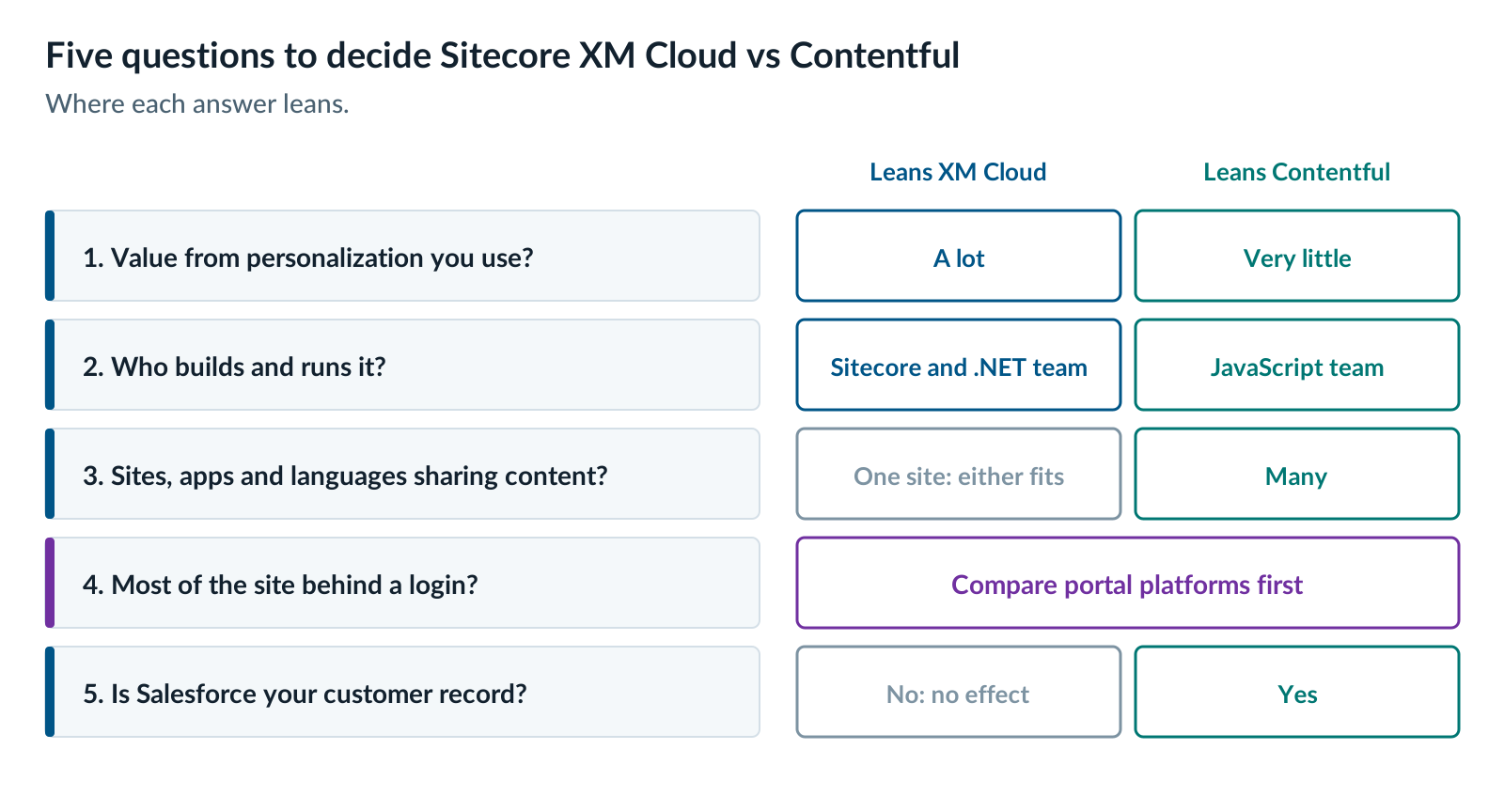
Here’s how to act on the result. If your answers lean toward personalization and an in-house Sitecore team, build your XM Cloud business case. If they lean toward channels, languages and a JavaScript team, start with a short Contentful proof of concept. If the login side dominates, compare portal platforms first. Our decision rule for Contentful vs Liferay and the CMS or platform diagnostic can help.
When you’re ready to plan the move itself, read Sitecore to Contentful: The Technical Migration Playbook. Or talk to our Contentful team. We’ll tell you if we think XM Cloud is the better fit.
Further reading
- SitecoreAI limitations and restrictions — the XP features that don’t carry over, from Sitecore
- Sitecore support lifecycle (KB0641167) — current XP support dates
- Contentful technical limits — API, locale and content model limits
- Salesforce signs agreement to acquire Contentful — the announcement and closing note
Kaushik Mukherjee leads XTIVIA’s Contentful practice and co-wrote XTIVIA’s guide to content modeling in Contentful. He helps teams plan and deliver moves from legacy CMS platforms to Contentful. Talk to us.