
Last reviewed: October 12, 2026
SUMMARY:
- AEM vs Contentful is rarely settled by license price; build, people, change and run costs usually decide the total cost of ownership.
- AEM as a Cloud Service has no big upgrade projects any more, and Adobe’s Edge Delivery Services can cut the developer cost of page changes.
- Contentful’s license is only part of its cost, because you also buy and run the front end, search, assets, personalization and analytics.
- AEM as a Cloud Service is the better choice when Assets, Target, Analytics or Real-Time CDP are central to how you work.
- Contentful can run alongside AEM on one domain, so you can move in phases and add the overlap to your worksheet.
Table of Contents
- Why AEM vs Contentful Is Not a License Comparison
- Four Costs a License Comparison Misses in AEM vs Contentful
- What Is the Developer-Dependency Tax?
- AEM vs Contentful for Multi-Brand and Multi-Market Sites
- AEM vs Contentful Capability Comparison
- When AEM as a Cloud Service Is the Better Choice
- Where Contentful Changes the Math
- Running Contentful Alongside AEM During a Phased Exit
- An AEM vs Contentful TCO Worksheet You Can Fill In
- Making the AEM vs Contentful Call
Why AEM vs Contentful Is Not a License Comparison
AEM vs Contentful is rarely decided by license price. For a team on AEM 6.5, the real choice is between two projects. One re-architects your site onto AEM as a Cloud Service. The other replatforms it onto a headless CMS like Contentful. The license is the line everyone compares first. It’s often not the line that decides the total.
Still weighing every path? Start with AEM 6.5 End of Support: Your Five Options, Honestly Compared. This article picks up once AEM as a Cloud Service and Contentful are both on the shortlist, and you need a business case.
Two quick definitions. AEM as a Cloud Service is Adobe’s software-as-a-service version of Adobe Experience Manager (AEM). Adobe runs it and keeps it current. Contentful is a headless CMS. A headless CMS stores content and sends it through an API to a separate front end. That might be a Next.js site or a mobile app.
A fair total cost of ownership (TCO) model counts both sides. AEM as a Cloud Service includes a lot that Contentful leaves you to buy. Contentful avoids some costs that AEM teams carry every month.
A disclosure before we start: XTIVIA is a Liferay Gold Partner and a Contentful partner. We don’t implement AEM. We’ve tried to make Adobe’s case as fairly as we can.
 The license is the smallest argument in AEM vs Contentful. Count what it costs to build, staff, change and run each platform for five years, on both sides.
Four Costs a License Comparison Misses in AEM vs Contentful
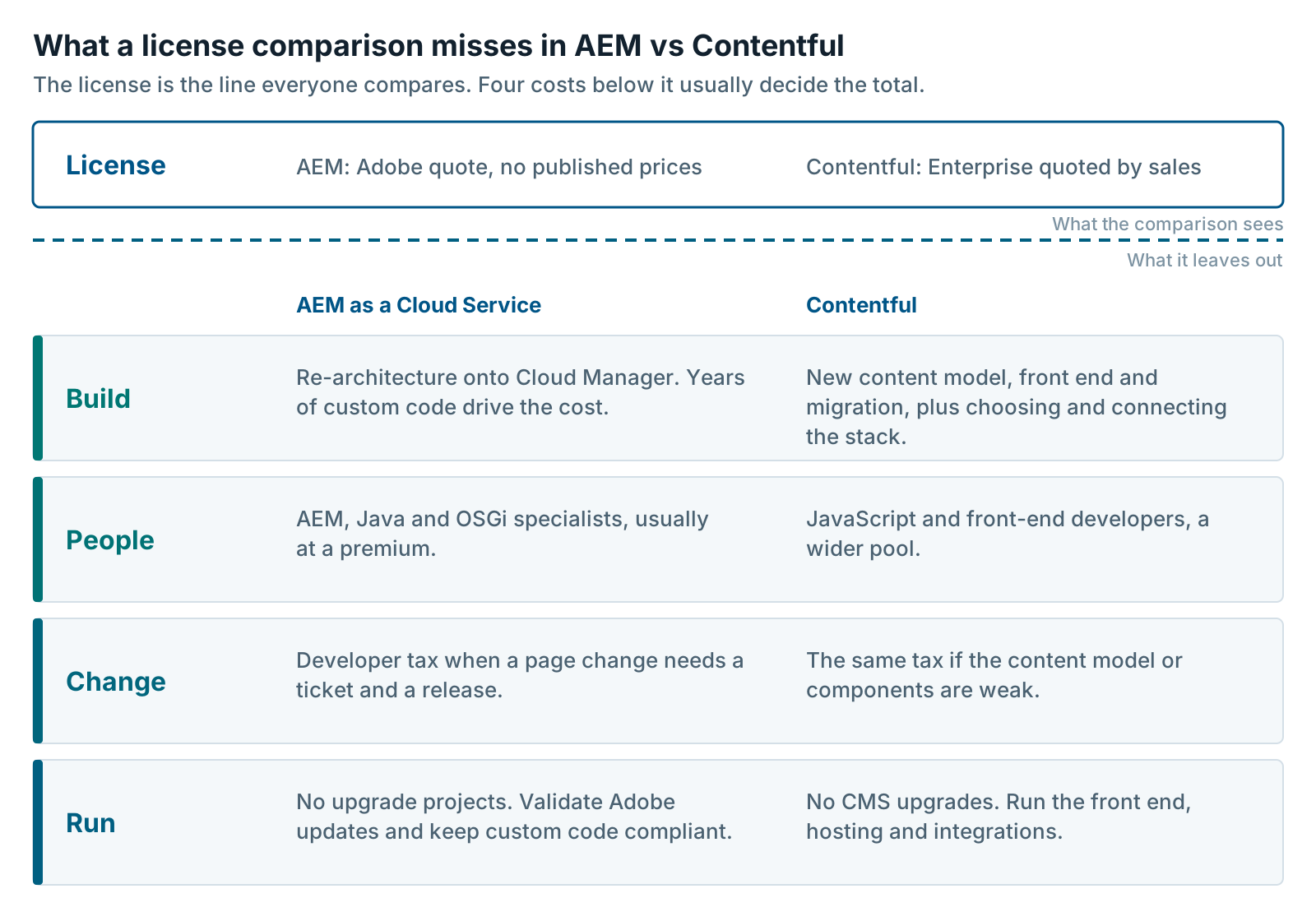
A license comparison misses four costs in AEM vs Contentful: building the platform, staffing it, changing content on it, and running it. Some are larger on AEM. One is larger on Contentful. Together they usually outweigh the license difference.
1. Build. On AEM as a Cloud Service, this is the re-architecture. Custom code moves to Adobe’s Cloud Manager pipeline, and years of customization become the main cost. On Contentful, it’s a new content model, a new front end and a content migration. Contentful also adds a cost AEM doesn’t have: you choose and connect the rest of the stack. That means front-end hosting, search, assets, personalization and analytics.
2. People. AEM work needs Java and OSGi skills, plus AEM know-how. In most markets we see, AEM specialists cost more to hire or contract than general JavaScript developers. Check this against your own rate cards. Contentful work mostly needs JavaScript and front-end skills, which are easier to find.
3. Change. This is the cost of every content or page change that needs a developer, a ticket and a release. It rarely shows up as its own line in a contract. We call it the developer-dependency tax, and the next section shows how to measure it.
4. Run. Here AEM as a Cloud Service deserves credit. It’s evergreen. According to Adobe’s documentation on AEM version updates, Adobe applies maintenance updates regularly and ships feature releases on a monthly schedule, through its own pipeline. If an update fails, Cloud Manager rolls it back. So the big version-upgrade project of the AEM 6.x years is gone.
What’s left on AEM is smaller but real. Your team validates Adobe’s updates through Cloud Manager pipelines and keeps custom code compliant as Adobe retires old APIs. Contentful updates itself, too. But you run the front-end app, its hosting and every integration around it.
What Is the Developer-Dependency Tax?
The developer-dependency tax is what you spend when routine content changes need a developer. A new landing page layout, a changed form or a new component variant becomes a ticket. Then it waits for a sprint, a test cycle and a release window. Little of that cost shows up as its own line in a license or an agency contract.
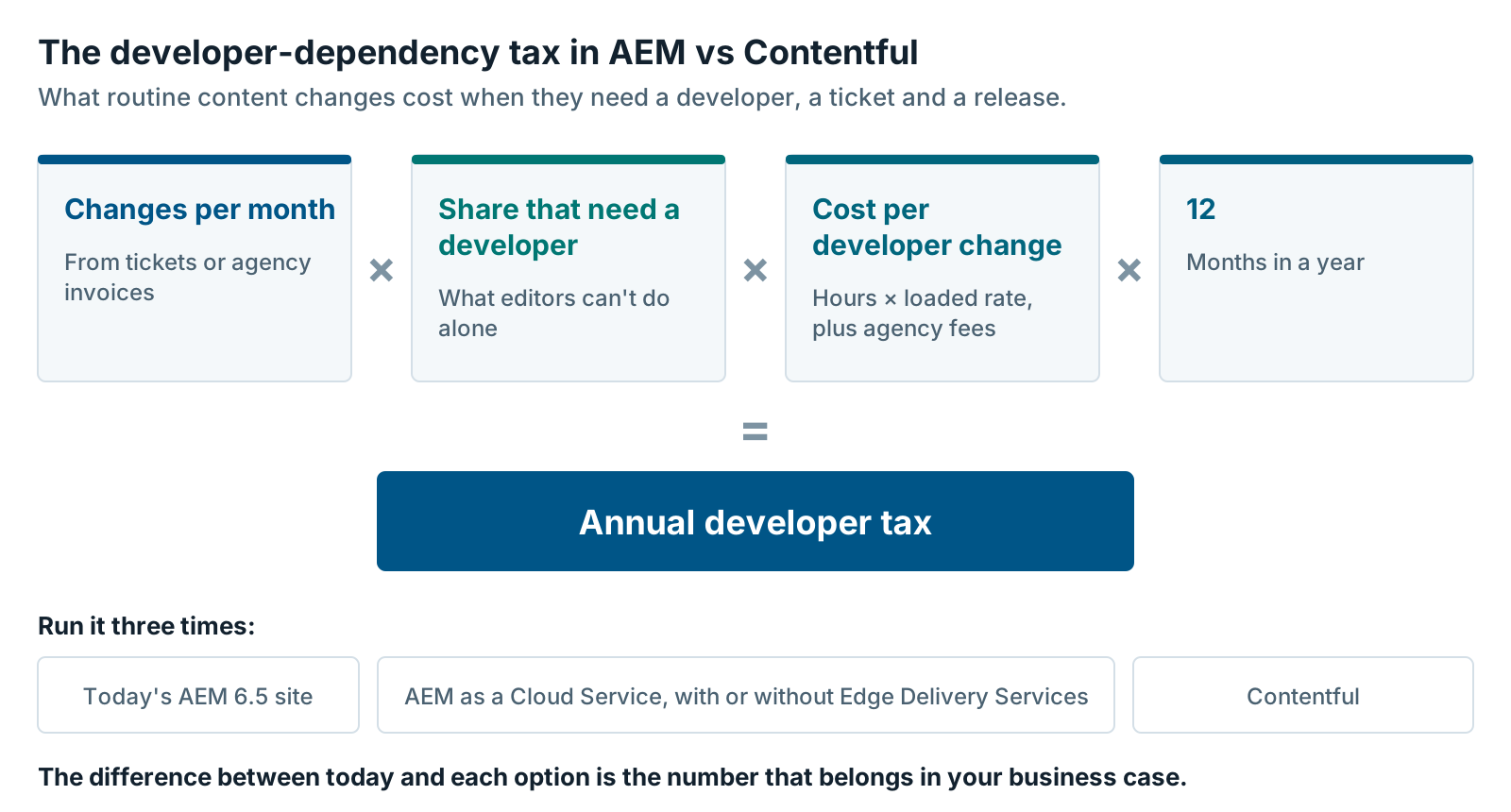
You can measure it with one formula.
Annual developer tax = changes per month × share that need a developer × fully loaded cost per developer change × 12.
- Changes per month. Count requests from marketing and content teams, from tickets or agency invoices.
- Share that need a developer. The fraction an editor can’t do alone.
- Fully loaded cost per developer change. Hours for every role that touches one change, times each role’s loaded hourly rate, plus agency fees.
Run the formula for today’s AEM site, then estimate it for each future platform. The difference belongs in your business case. Note the delay, too. A campaign page that takes three weeks to ship has a cost, even if it’s hard to price.
In the AEM assessments and platform reviews we’ve done, routine page changes often wait for a developer and a release. That’s usually because the site was built from rigid, custom components years ago. It’s a build problem more than a product problem.
Adobe has its own answer to this problem: Edge Delivery Services. Adobe’s authoring methods guide lists document-based authoring, where authors write pages in Microsoft Word or Google Docs. It also lists the Universal Editor, a visual editor. Developers build reusable blocks in JavaScript and CSS.
For some teams, that cuts the developer tax a lot. It helps most when:
- you’re rebuilding on AEM as a Cloud Service anyway,
- your site is mostly marketing pages, not structured content reused across channels,
- and a library of blocks will cover most of what editors need.
It helps less in other cases. Moving an existing AEM site to Edge Delivery Services is still a front-end rebuild into blocks. Adobe’s own Experience Modernization Agent overview lists the work that still needs developers. That includes third-party integrations, custom business logic, MarTech and experimentation, and multisite inheritance. If your content must feed apps and many sites, a headless content model may still fit better.
Contentful doesn’t escape this tax either. A weak content model or a thin component library creates the same tickets. The tax drops only when editors can do most changes alone.
AEM vs Contentful for Multi-Brand and Multi-Market Sites
In AEM vs Contentful, multi-brand and multi-market sites are where cost differences grow fastest. Every extra brand, country or language multiplies whatever each one costs to run. So the question is how much work each new market repeats.
AEM has mature tools for this. Multi Site Manager (MSM) creates live copies of a blueprint site, and changes roll out from the source to each copy. Language copies handle translation. Used well, one AEM program can serve many markets.
The cost shows up in two places. First, live copy inheritance needs steady governance. Once local teams break inheritance on many pages, rollouts stop helping and the copies drift apart. Second, some AEM teams we’ve talked to run a separate instance or program per brand or region. Each one repeats its own code, releases and content work.
Contentful handles markets differently. One space can hold many locales, with fallback from one locale to another. A product description written once can serve every market, with local overrides where needed. That’s where single-instance localization can save the most effort.
Contentful has its own costs here, too. Separate brands often get separate spaces, and the Free and Lite plans cap how many you get. Sharing content across spaces needs design work.
Use this simple test for your worksheet.
Repeated market cost = markets × repeated work per market per year.
Repeated work is anything done again for each market that could have been shared. Estimate it for AEM today and for each future option.
AEM vs Contentful Capability Comparison
On capabilities, AEM vs Contentful splits clearly. AEM as a Cloud Service leads on digital asset management, experimentation, analytics, authoring options and workflow. Contentful leads on content reuse, delivery to many channels, pricing transparency and talent. The rest is close.
| Capability | AEM as a Cloud Service | Contentful | Edge |
|---|---|---|---|
| Content modeling | Content Fragment models for structured content. Page components for pages. | Content types and references, built for reuse across channels | Contentful |
| Page building and authoring | Page Editor, Universal Editor, and document-based authoring with Edge Delivery Services | Web editor, plus Studio for visual page building, sold separately | AEM |
| Digital asset management (DAM) | AEM Assets, often the DAM of record across the business | Media library for web assets. Large libraries usually need a separate DAM. | AEM |
| Personalization and testing | Adobe Target for deep experimentation, licensed separately | Contentful Personalization, an add-on to the Enterprise plan, or a third-party tool | AEM |
| Analytics and customer data | Adobe Analytics and Real-Time CDP, licensed separately | You add your own analytics and customer data platform | AEM |
| Delivery to many channels | GraphQL and an OpenAPI-based REST API for Content Fragments, plus page delivery | REST and GraphQL APIs on a global CDN, headless from the start | Contentful |
| Multi-market sites | MSM live copies and language copies. Mature, but needs governance. | Many locales in one space, with fallback. Brands often get separate spaces. | Close |
| Governance and workflow | AEM workflows and launches. Mature and customizable. | Roles, tasks, scheduled publishing and releases. Multi-step approvals need setup. | AEM |
| Upgrades and operations | Evergreen. You keep custom code compliant through Cloud Manager. | No CMS upgrades. You run the front end and its hosting. | Close |
| Pricing transparency | No published prices | Free and Lite plans published. Enterprise quoted by sales. | Contentful |
| Talent pool | AEM, Java and OSGi specialists | General JavaScript and front-end developers | Contentful |
Two rows deserve a closer look.
DAM. Adobe was named a Leader in The Forrester Wave: Digital Asset Management Systems, Q1 2026, according to Adobe’s announcement. In many companies, AEM Assets serves print, product and brand teams far outside the website. If that’s you, leaving AEM Sites doesn’t mean leaving Assets. Contentful’s own Adobe Experience Manager Asset Selector app lets editors pick approved assets from AEM as a Cloud Service inside a Contentful entry.
Pricing. Adobe doesn’t publish AEM as a Cloud Service prices. Contentful publishes its Free and Lite plan prices on its pricing page and quotes its Enterprise plan through sales. Personalization is an add-on to Enterprise, and Studio is priced separately. At enterprise scale, both are negotiated.
When AEM as a Cloud Service Is the Better Choice
AEM as a Cloud Service is the better choice when the rest of the Adobe suite does real work in your business. If Assets, Target, Analytics or Real-Time CDP are part of how you run marketing every day, leaving AEM Sites means rebuilding those connections. That cost often outweighs any CMS savings.
It’s usually the right call when:
- AEM Assets is your DAM of record. Brand, product and print teams depend on it, not just the website.
- Adobe Target drives revenue. Your team runs real tests every month, and the results change decisions.
- Adobe Analytics and Real-Time CDP are wired into your marketing. Audiences and journeys depend on those connections.
- You have a strong in-house AEM team. Their skills keep their value through the re-architecture.
- Edge Delivery Services fits your site. A page-centric marketing site with a solid block library may get much of the speed benefit while staying on Adobe.
If your AEM site also runs a large logged-in portal, that part needs its own decision. Read AEM vs Liferay for Portals: What to Do With the Login Side of AEM.
Where Contentful Changes the Math
Contentful changes the math when you use AEM mostly as a CMS. If Target, Analytics and Real-Time CDP are unused or only lightly used, much of the suite’s value isn’t reaching you. Then a content platform plus a few chosen tools can cost less to change and run.
Contentful tends to win when:
- The same content must reach many places. Websites, apps, kiosks, partner feeds and AI assistants can all pull from one structured entry.
- Editors are blocked by developers today. A good content model and component library let editors ship most changes alone.
- Your team writes JavaScript, not Java. You hire for the stack you already use.
The trade-off is assembly. Contentful is a content platform, not a suite. You pick and pay for front-end hosting, search, assets, personalization and analytics. Many Contentful sites, for example, add a search service such as Algolia. Our guide to integrating Contentful, Algolia and Next.js shows what that involves.
Salesforce now owns Contentful, after closing the deal on September 1, 2026. For a view of what that changes, read Is Contentful Right for Enterprise? A Practitioner’s Evaluation.
Running Contentful Alongside AEM During a Phased Exit
Contentful can run alongside AEM during a phased exit, so you don’t have to move everything at once. Both platforms serve one domain. Routing at the edge sends each section of the site to whichever platform now owns it. Visitors see one site the whole time.
Here’s how it works in practice:
- Put a routing layer in front of both. Your CDN sends requests by path. For example, /blog goes to the new front end and everything else still goes to AEM. Keep URLs stable, and update redirects and the sitemap each time a section moves.
- Share the design. Both front ends use the same design tokens, such as colors, fonts and spacing. That keeps the seam invisible.
- Move one section at a time. Pick sections by traffic, how often they change and how tied they are to AEM code.
- Keep the Adobe tools that still earn their place. Adobe Analytics and Target can run on pages from both platforms. AEM Assets can stay your DAM.
- Retire each section in AEM once its new version is live and checked.
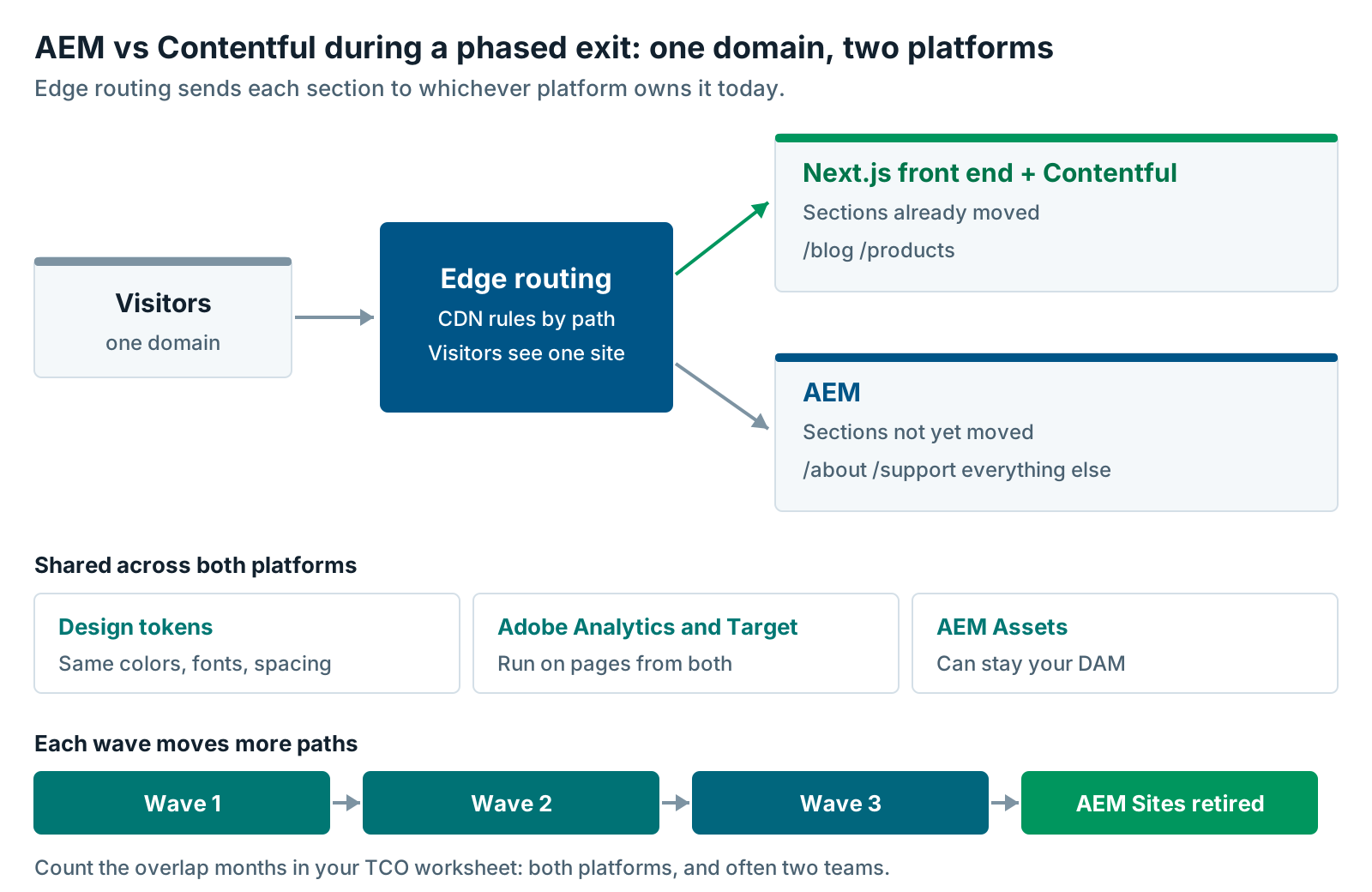
Coexistence has a cost, and your worksheet should show it. For the months of overlap, you pay for both platforms and often two teams. Contentful Migration Without Freezing Your Roadmap covers how to plan the waves. The technical detail is in AEM to Contentful Migration: The Technical Playbook.
An AEM vs Contentful TCO Worksheet You Can Fill In
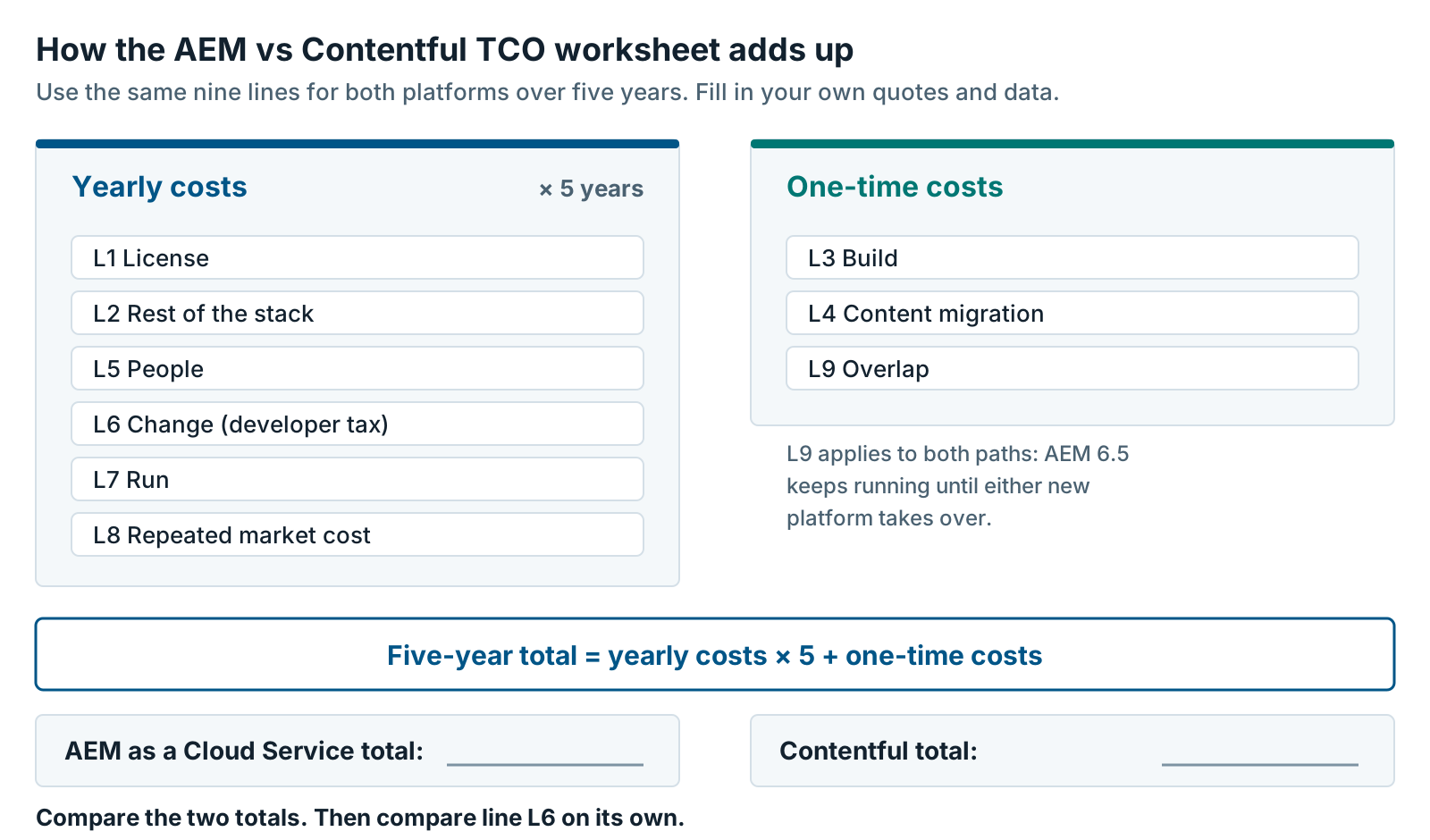
This AEM vs Contentful TCO worksheet covers five years and both platforms. Fill in each line with your own quotes, rate cards and ticket data. Leave a line blank only if it’s truly zero. The aim is a fair total, not a winning one.
| Line | AEM as a Cloud Service | Contentful | How to work it out |
|---|---|---|---|
| L1. License | Adobe quote for AEM Sites (and Edge Delivery Services, if separate) | Contentful quote for your tier, Studio and Personalization if used | Annual quote × 5 |
| L2. Rest of the stack | Target, Analytics, Real-Time CDP, if you’ll keep them | Front-end hosting, search, DAM, personalization, analytics, CDP | Sum of annual quotes × 5 |
| L3. Build | Re-architecture onto Cloud Manager | Content model, front end, integrations | Partner estimate, one time |
| L4. Content migration | Content moves and clean-up | Content moves, rich-text conversion and clean-up | Pages or items × effort per item × loaded rate |
| L5. People | Team size × loaded rate, with the AEM specialist premium | Team size × loaded rate | (FTEs × loaded annual cost) × 5 |
| L6. Change (developer tax) | Changes per month × share needing a developer × cost per change × 12 | Same formula, with your estimated share | Annual result × 5 |
| L7. Run | Validating Adobe updates, keeping custom code compliant, CDN rules | Front-end hosting operations, dependency updates, integration upkeep | Hours per month × loaded rate × 60 |
| L8. Repeated market cost | Markets × repeated work per market | Markets × repeated work per market | Annual result × 5 |
| L9. Overlap | Months AEM 6.5 runs alongside the cloud build × monthly cost of 6.5 and its team | Months AEM and Contentful both run × monthly cost of AEM and its team | One time |
| Five-year total | Sum of L1–L9 | Sum of L1–L9 | Compare the totals, then compare L6 alone |
Four tips make the worksheet more useful.
- Use real five-year quotes for L1 and L2. List prices tell you little at enterprise scale.
- Be fair on L2. If you’ll keep Adobe Analytics and Target either way, put them on both sides.
- Get L6 from data. Pull last year’s tickets or agency invoices. Don’t guess the share that needs a developer.
- Check L9 with the business. A longer overlap costs more but lowers risk.
Making the AEM vs Contentful Call
The AEM vs Contentful call comes down to how much of Adobe’s suite you actually use, and what routine change costs you today. Fill in the worksheet with your marketing lead and IT owner together. Then let the totals, and line L6 on its own, point the way.
Here’s how to act on the result:
- The Adobe suite does real work for you. Build your AEM as a Cloud Service business case, and look hard at Edge Delivery Services to cut the developer tax.
- You mostly use AEM as a CMS, and the developer tax is high. Run a short Contentful proof of concept on one real section of your site.
- The login side of your site is large. Separate it first. A portal may need a different platform from your public website.
- You’re not sure which workload you have. Start with Legacy DXP Migration: Are You Replacing a CMS or a Platform? or our decision rule for Contentful vs Liferay.
If your AEM partner is in the room, give them the same worksheet. A fair comparison uses the same nine lines on both sides.
When you have your numbers, our Contentful team is happy to review the worksheet with you. If AEM as a Cloud Service comes out ahead, we’ll tell you so.
Further reading
- AEM as a Cloud Service version updates — how Adobe keeps the platform current, from Adobe
- Methods to author content in AEM — Universal Editor, document-based authoring and the other options
- Experience Modernization Agent overview — what moving to Edge Delivery Services automates, and what it doesn’t
- Contentful pricing — published tiers and what each includes
Kaushik Mukherjee leads XTIVIA’s Contentful practice and co-wrote XTIVIA’s guide to content modeling in Contentful. He helps teams plan and deliver moves from legacy CMS platforms to Contentful. Talk to us.