

By Pavan Malpani, Fabric Practice Delivery Lead, XTIVIA
Last reviewed: November 23, 2026
SUMMARY:
- The Purview Data Governance retirement ends support for Purview Unified Catalog and the classic governance features on November 12, 2027; security and compliance features are not affected.
- New Purview data governance accounts can no longer be created, and existing ones stay in maintenance mode until support ends.
- Microsoft now treats the Fabric OneLake catalog as its data governance solution, included in Fabric capacity rather than billed through separate meters.
- The OneLake catalog doesn’t yet match everything Purview did, including the glossary, critical data elements, data quality rules and scanning outside Fabric.
- If you use Purview governance today, inventory it now, pilot one path in Fabric, and move in waves well before the deadline.
Table of Contents
- What Is the Purview Data Governance Retirement?
- Purview Data Governance Retirement Timeline
- What Stays in Microsoft Purview
- Where Data Governance Goes Now
- What the OneLake Catalog Doesn’t Cover Yet
- What to Do About the Purview Data Governance Retirement
- When the OneLake Catalog Isn’t Enough
- Our Earlier Articles and the Purview Data Governance Retirement
- Changes to This Guide
What Is the Purview Data Governance Retirement?
The Purview Data Governance retirement is Microsoft’s decision to stop supporting the governance half of Microsoft Purview. Microsoft announced it on November 12, 2026. Support ends on November 12, 2027. Microsoft Purview itself is not going away. Its data security and compliance features carry on as before.
The retirement covers Purview Unified Catalog and the classic governance features that started life as Azure Purview, such as the Purview Data Map. Unified Catalog is where teams built governance domains, data products, glossary terms and data quality rules. Microsoft’s announcement puts it plainly: “Microsoft Purview stays focused on data security and compliance.”
 Microsoft is retiring Purview’s data governance features, not Purview. Your sensitivity labels, data loss prevention and audit work keep running exactly as they do today.
We wrote this guide for leaders who need the whole picture in one place. You don’t need any of our earlier articles to follow it. If you landed here from one of them, this is the current version of the story.
Purview Data Governance Retirement Timeline
Two dates matter, and the first one has already passed. On November 12, 2026, Microsoft announced the change. New Purview data governance accounts can no longer be created. Existing accounts keep working in maintenance mode until support ends on November 12, 2027.
Microsoft Learn’s retirement notice confirms each step. Microsoft hasn’t defined “maintenance mode,” so expect the features to keep running with fixes only, and the tools you have today to stay as they are.
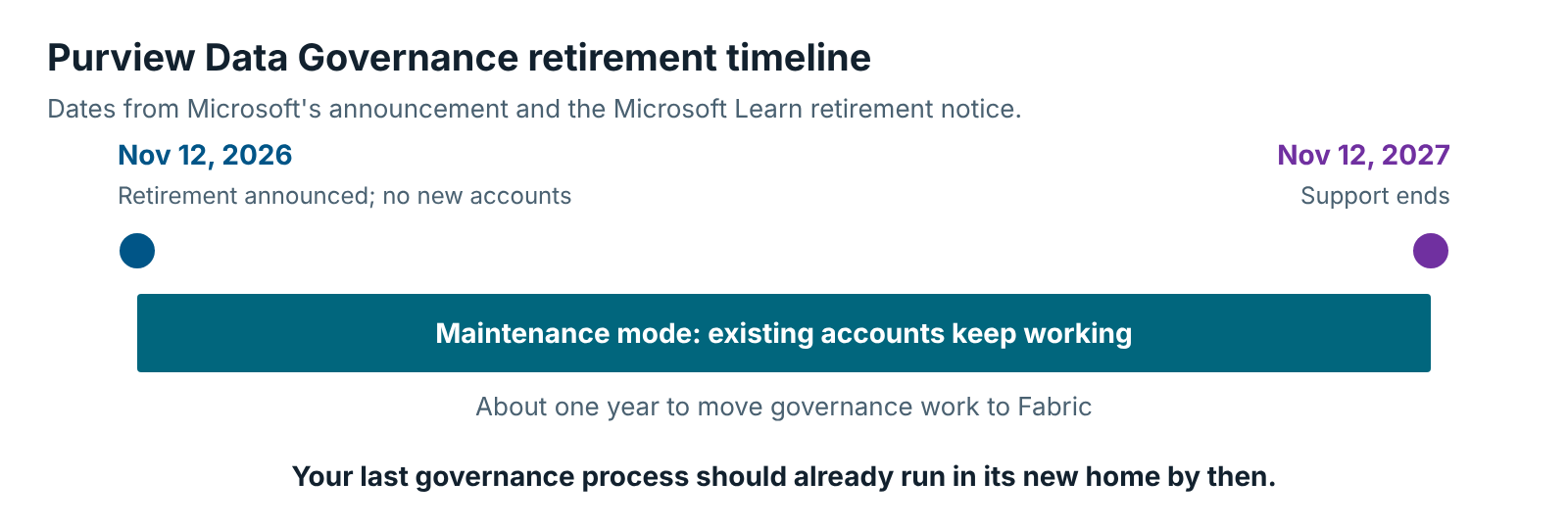
A year sounds like plenty. In practice, governance work runs through people: owners, stewards and approvers. In our experience, getting them to agree on a new home takes longer than moving the metadata.
What Stays in Microsoft Purview
Everything that protects data or proves compliance stays in Purview, and Microsoft says it will keep investing in it. That is most of what our clients use Purview for day to day. None of it needs to move, and none of it changes because of this announcement.
What stays:
- Sensitivity labels. Tags that classify and protect files, emails and Fabric items.
- Data loss prevention (DLP). Rules that warn or block when sensitive data is shared the wrong way.
- Insider Risk Management. Alerts on risky behavior, such as a departing employee downloading large amounts of data.
- Data Security Posture Management (DSPM). A view of where sensitive data sits and who can reach it, including for Copilot and AI agents.
- Audit, retention and eDiscovery. A record of who did what, how long you keep it, and how you find it for legal requests.
- Compliance Manager. Tracking against regulations and standards.
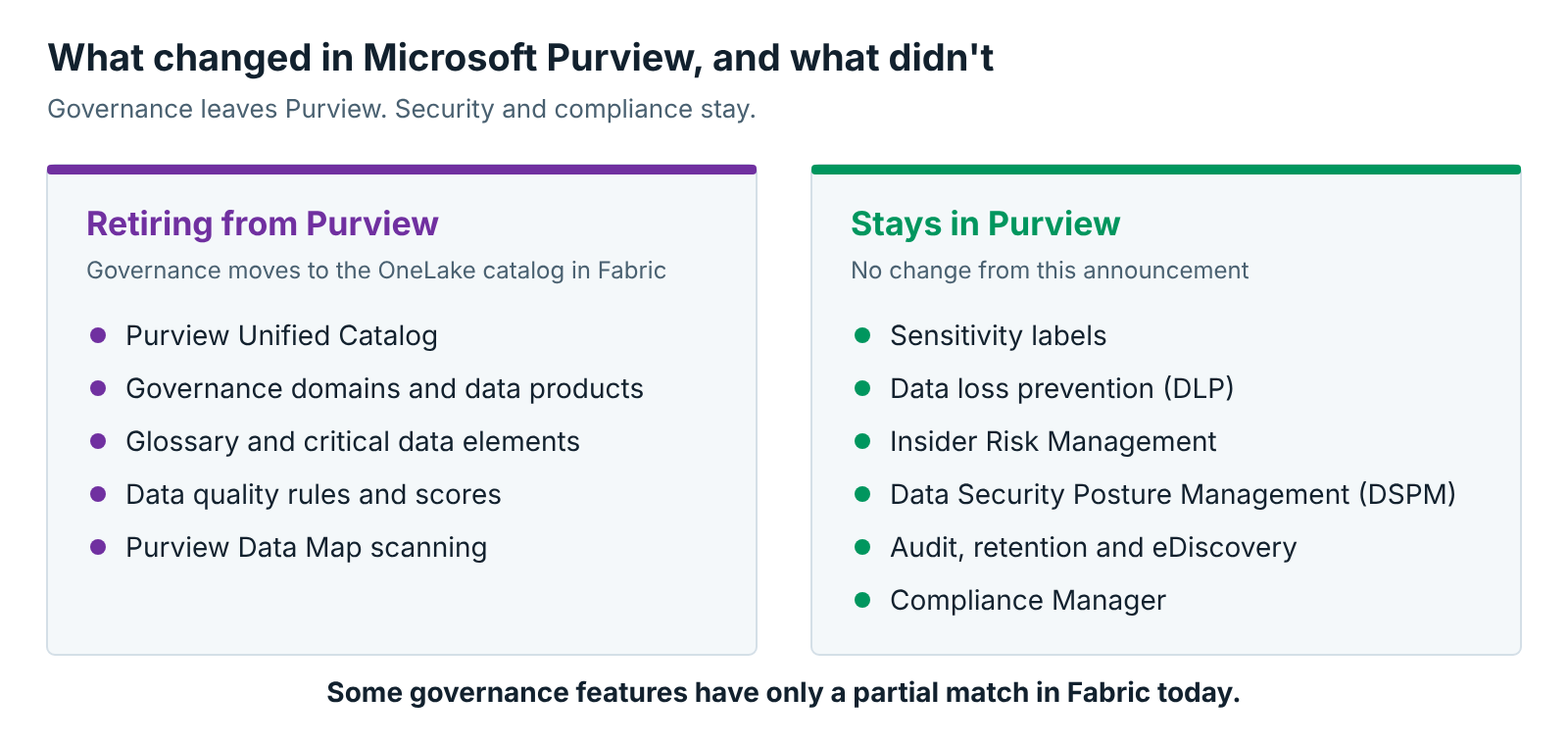
If you use Purview only for labels, DLP or audit, this retirement asks nothing of you. Your licences, policies and reports carry on unchanged.
Where Data Governance Goes Now
Data governance moves to the OneLake catalog in Microsoft Fabric. The OneLake catalog is Fabric’s built-in place to find, sort and govern data. Microsoft calls it “the single foundation” for governing data. It comes with Fabric capacity, so there is no separate meter to pay. It has three tabs: Explore to find data, Govern to check and improve governance, and Secure to review who can access what.
Microsoft’s architects map each Purview feature to Fabric in their transition guide, updated November 16, 2026; we added the OneLake catalog tab for each. Here is the short version:
| What you did in Purview | OneLake catalog tab | Where it goes in Fabric today | How complete |
|---|---|---|---|
| Search and browse the catalog | Explore | Search, filters, domain selector and item details | Covers Fabric items |
| Governance domains and ownership | Govern | Fabric domains, subdomains and domain admins | Close match |
| Glossary and critical data elements | Govern | Tags, descriptions and endorsement | Partial |
| Data products | Govern | Domains, endorsement and sharing | Partial |
| Lineage | Explore | Lineage in item details, for supported items | Supported Fabric items only |
| Data quality rules and scores | Govern | Freshness and curation insights | Not a rules engine |
| Access requests | Explore and Secure | Request access in Explore; review roles and permissions in Secure | Partial |
Governance becomes part of the data platform, not a separate product. For many teams that is simpler. It also means your Fabric team now owns work a separate governance group may have done.
What the OneLake Catalog Doesn’t Cover Yet
The OneLake catalog has real gaps today, and Microsoft’s own architects list them. Their guide tells teams not to claim full parity for the glossary or critical data elements. Critical data elements are business-defined fields, like “Customer ID,” mapped across many tables. Plan for each of these gaps before you switch anything off:
- Glossary and critical data elements. No full equivalent. Export and keep your terms and owners.
- Data quality. Fabric’s governance health view is “not a rules, profiling, and scoring engine.” Keep data quality checks in your pipelines or another tool.
- Sources outside Fabric. Connecting data to Fabric is not the same as scanning its metadata. Purview could scan Snowflake, AWS or on-premises SQL Server. The OneLake catalog doesn’t scan them; it sees only what you bring into Fabric through shortcuts, mirroring or connectors.
- Data products. Product owners, contracts and access rules may need to live outside the catalog for now.
- Access request workflows. Keep your approval and revoke process where Fabric doesn’t cover it end to end.
- Fabric Policies. Still in preview, with “Allow” as the only effect, three policy types and no support yet in some regions.
Microsoft publishes what arrives next on the Fabric roadmap. Some of these gaps may close before November 2027. Plan on today’s features, and treat roadmap items as a bonus when they land.
What to Do About the Purview Data Governance Retirement
What you should do depends on whether you use Purview governance today. Most organizations fall into one of three groups. Find yours below. Each group has a different amount of work before November 12, 2027.
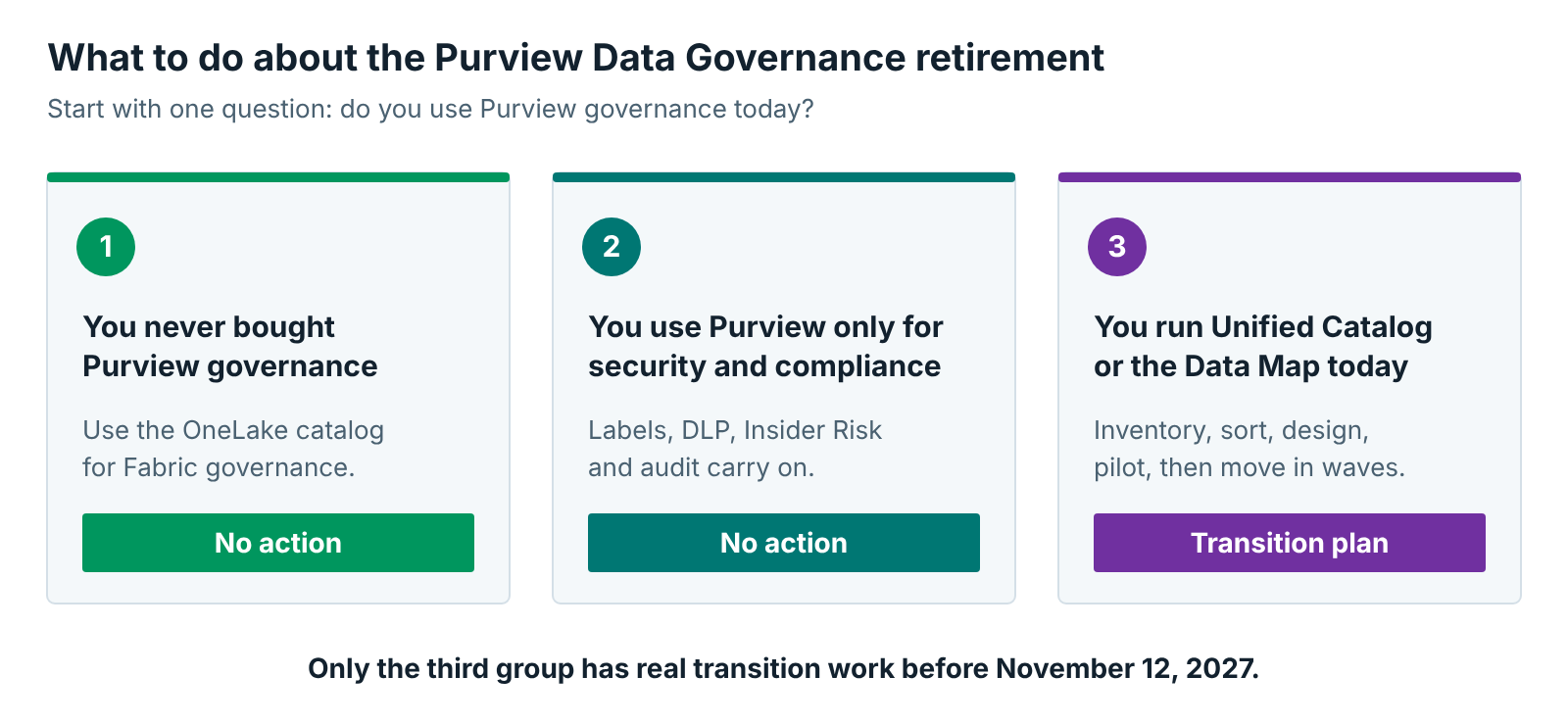
1. You never bought Purview governance. Nothing to undo. Use the OneLake catalog for Fabric governance, and keep or add Purview for security and compliance.
2. You use Purview only for security and compliance. No action needed. Labels, DLP, Insider Risk Management and audit carry on. Microsoft’s guidance is that Purview stays focused on exactly this work.
3. You run Purview Unified Catalog or the Data Map today. You have transition work. We recommend five steps, built on the ones Microsoft’s architects publish:
- Inventory what you have. Sources, scans, domains, owners, glossary terms, data products, data quality rules, workflows and access policies.
- Sort each item. Move it now, run both for a while, bridge it with a process or partner tool, or redesign it.
- Design the Fabric setup. Domains, workspace owners, who certifies data, and how Fabric hands off to Purview for labels and DLP.
- Pilot one path end to end. Test discovery, lineage, access, labels and audit. Include a user who should be denied, and prove they are.
- Move in waves. Turn off a Purview feature only after its replacement passes agreed tests.
If you have contract obligations or work in a highly regulated industry, Microsoft asks you to contact your Microsoft account team early. We’d add one more step: tell your auditors now, before the change shows up in their evidence requests.
We delivered Purview governance for a pension fund and benefits company before this announcement, including a glossary, data products and data quality rules. That work is exactly what this transition affects. Our forthcoming From Purview Data Governance to the OneLake Catalog: A Transition Playbook covers each step in detail.
When the OneLake Catalog Isn’t Enough
The OneLake catalog fits best when most of your governed data lives in Fabric. It is a weaker fit when you need to govern a large amount of data outside Microsoft. It also struggles when your glossary and data quality rules are central to how the business runs.
In those cases, a dedicated catalog may serve you better. Microsoft’s announcement names Atlan, Alation, Collibra and Informatica as catalog providers that work with Fabric. Each scans sources well beyond Fabric. Each adds licence cost and another tool to run.
Worth saying plainly: XTIVIA is a Microsoft partner, and we implement both Fabric and Purview. We still recommend a dedicated catalog when your data and governance needs reach well beyond Microsoft. Our comparison, Data Governance Tools for Microsoft Fabric: OneLake Catalog vs. Collibra, Atlan, Alation and Informatica, is coming in December 2026.
There is also a case for waiting. If your governance needs are light today, stay with the OneLake catalog. Revisit the decision when Microsoft closes the gaps above or your needs grow.
Our Earlier Articles and the Purview Data Governance Retirement
We wrote 16 articles on Microsoft Purview before this announcement. They stay online as written. They record how we delivered Purview at the time. Each affected article now has a dated notice that points here.
Our security articles are not affected. They cover sensitivity labels, DLP for Fabric, Information Protection, Copilot readiness and Fabric data agents. For prices, read our new Microsoft Purview Pricing for Fabric: Security and Compliance. It replaces the pricing article above.
Changes to This Guide
We update this guide as Microsoft ships new OneLake catalog features and changes its plans. Each change is dated below. Check “Last reviewed” at the top for the most recent review of the Purview Data Governance retirement facts.
- November 23, 2026: First version, based on Microsoft’s November 12 announcement, the Microsoft Learn retirement notice and the Microsoft architects’ transition guide.
If you are planning a transition and want a second opinion, our Microsoft Fabric consulting and Microsoft Purview services teams can help.
Further reading
- A next step in the evolution of the Microsoft Data Governance strategy — Microsoft’s announcement, November 12, 2026
- Learn about Microsoft Purview Unified Catalog — Microsoft Learn, with the retirement notice
- From Purview Data Governance to the Fabric OneLake Catalog — Microsoft architects’ feature mapping and transition steps
- Microsoft Fabric roadmap — what’s coming to the OneLake catalog
Pavan Malpani is the Fabric Practice Delivery Lead at XTIVIA, where he leads Microsoft Fabric and Purview delivery for clients. Talk to us.